
Last updated July 11, 2026
The Complete Guide to Gate Repair in Wichita
The most expensive gate repair mistake isn’t ignoring a problem — it’s fixing the wrong component first. A Wichita homeowner who replaces a motor because the gate won’t open may have paid $900 to solve what was actually a $40 limit switch. After 20 years of diagnosing gate systems across Sedgwick County, we’ve seen this pattern repeat: a frustrated customer calls after another contractor’s “fix” failed, and we trace the real issue to a completely different part of the system. This guide maps the five failure zones of every automatic gate, shows you how Wichita’s clay soil and freeze-thaw cycles create unique structural stresses, and explains what accurate diagnosis actually looks like — so you don’t pay for someone else’s guess.
Quick Answer
Gate repair in Wichita typically costs between $150 and $850 depending on which of the five gate system zones has failed — structural, mechanical, electrical, access control, or surface deterioration. Most residential repairs in Wichita are completed same-day, with common fixes including post realignment from clay soil shift, operator motor replacement, and access control keypad reprogramming. A proper diagnosis requires testing across all five zones, not just the symptom.
Table of Contents
- The Five Failure Zones of Every Gate System
- How Wichita’s Clay Soil Destroys Gate Alignment
- What Real Gate Diagnosis Looks Like
- When Fabrication Beats Replacement
- How to Document Your Gate Problem Before Calling
- Gate Repair Costs in Wichita
- Wichita’s Most Common Gate Brands and What Fails
- Preventive Maintenance for Wichita Gates
The Five Failure Zones of Every Gate System
Every automatic gate — whether a residential swing gate in Riverside or a commercial slide gate near Eisenhower Airport — contains five distinct zones where failure occurs. Misidentifying which zone is causing your symptom is how a $200 repair becomes a $2,000 replacement.
Zone 1: Structural (Posts, Hinges, Frame)
The structural zone carries every moving part. When posts shift, hinges bind, or frames twist, the operator strains, overheats, and eventually fails. In Wichita, this is the most commonly misdiagnosed zone because the symptom looks mechanical: the gate “won’t open,” so homeowners replace the motor. We’ve arrived at jobs in College Hill where the previous contractor installed a new LiftMaster operator on a gate whose post had settled three inches into clay soil. The new motor burned out in six weeks.
Structural warning signs:
- Gate drags or scrapes the ground at one end of its swing
- Visible gap between post and concrete footing
- Hinge bolts work loose repeatedly after tightening
- Gate frame shows diagonal cracking at weld points
Zone 2: Mechanical (Operator, Motor, Gearbox)
The mechanical zone includes the operator arm or slide mechanism, the motor, and the gearbox. These components have finite lifespans — typically 10-15 years for residential operators in Wichita’s climate, less for high-cycle commercial units. When a motor fails, it’s usually from cumulative strain: running against structural resistance, operating in temperature extremes, or simply reaching cycle count.
Mechanical failures announce themselves differently than structural problems. A stripped gearbox produces a grinding sound with no movement. A failed capacitor causes humming without action. A seized motor draws high amperage and trips breakers. These are actual mechanical failures, not structural symptoms masquerading as mechanical ones.
Zone 3: Electrical (Wiring, Circuit Boards, Transformers)
Wichita’s electrical zone failures spike after spring storms and summer heat waves. Lightning strikes near Maize or Andover induce voltage spikes that fry circuit boards. Rodents in control boxes — common near the Arkansas River corridor — chew low-voltage wiring. Corroded terminal blocks from humidity create intermittent faults that frustrate DIY troubleshooters.
The electrical zone is where parts-swapping contractors waste the most customer money. A dead operator might need a $12 fuse, a $180 circuit board, or a $680 motor replacement — but without systematic voltage testing across the control circuit, you’re guessing.
Zone 4: Access Control (Keypads, Loops, Intercoms)
Access control sits at the boundary between gate systems and electronics. Keypads fail from moisture infiltration, loop detectors from pavement cracking over the wire, intercoms from line voltage issues. In Wichita’s market, we’ve noticed Mighty Mule wireless keypads have particular vulnerability to range degradation in areas with new construction interference.
Access control symptoms are distinctive: the gate works fine from the inside remote but not the keypad, or the loop doesn’t detect vehicles but the manual button works. These are zone 4 problems, not zone 2 or 3.
Zone 5: Surface and Material Deterioration
Wrought iron gates in Delano, aluminum gates in Crown Heights — every material degrades differently in Wichita’s climate. Powder coating chalks under UV exposure. Galvanized steel rusts at weld points where the coating burned away. Wood gates in Old Town absorb moisture and swell, binding against operators calibrated for smoother movement.
Surface deterioration becomes a functional problem when it changes the gate’s weight, balance, or resistance profile. A gate that gained 40 pounds from rust scale operates its motor at higher load, shortening lifespan.
How Wichita’s Clay Soil Destroys Gate Alignment
Wichita sits on the Wellington Formation, a dense clay-shale layer that expands when wet and contracts during drought. This isn’t abstract geology — it’s the reason your gate worked fine in April and drags by August.
Clay soil exerts tremendous lateral pressure on gate posts. A 4×4 steel post set in concrete acts as a lever: when the clay swells, it pushes the post base; when it dries, the post settles into the void. After three to five Wichita freeze-thaw cycles, posts that were plumb are visibly tilted. The gate frame twists. Hinges bind. The operator — calibrated for a gate swinging through a precise arc — encounters resistance it wasn’t designed for.
Here’s how to tell if your “operator problem” is actually structural:
- Check post plumb with a level. Place a 4-foot level against the post on two perpendicular faces. More than 1/4 inch out of plumb over 4 feet indicates soil movement.
- Measure gate clearance at multiple points. A gate that’s level when closed but drags when opening has a twisted frame or shifted hinge — not a motor problem.
- Disconnect the operator and test manually. If the gate won’t move smoothly by hand, no motor replacement will fix it.
- Inspect the concrete footing. Cracking, tilting, or soil separation from the concrete collar means the post base has moved.
In our experience across Wichita’s established neighborhoods — College Hill, Riverside, Delano — homes built before 1980 have the worst post stability. Footings were often shallow (24-30 inches) in an era before modern gate loads. Newer construction in northeast Wichita and Andover generally has deeper footings but faces heavier clay expansion from irrigation systems keeping soil saturated.
Structural realignment in Wichita typically runs $400-$800 for residential posts, depending on whether we can brace and re-plumb existing footings or must excavate and pour new ones. Compare that to $1,200-$2,000 for operator replacement on a gate that will destroy the new motor in months.
What Real Gate Diagnosis Looks Like
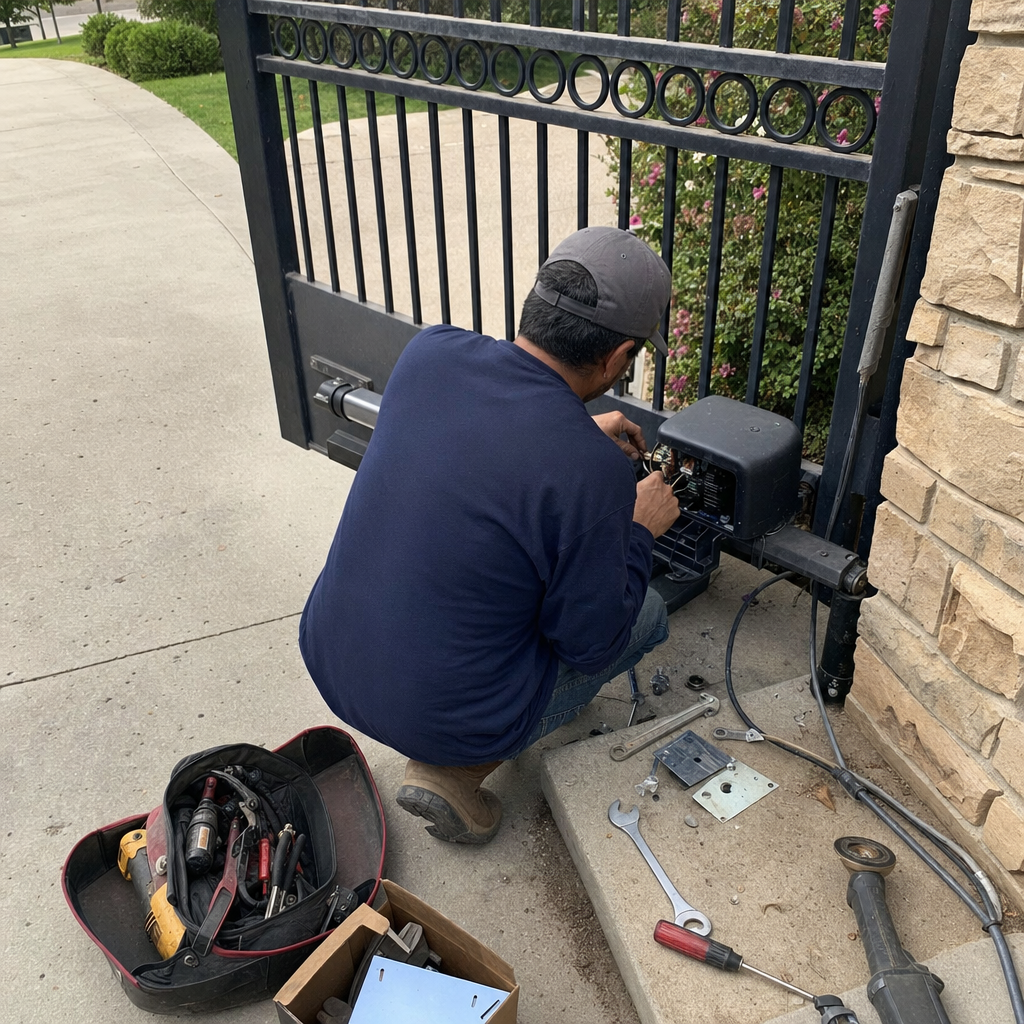
There’s a difference between troubleshooting and parts-swapping. When Douglas Ross arrives at a Wichita gate repair, the process is systematic — not because it’s slow, but because 20 years of gate-only experience has taught us that the obvious symptom is rarely the root cause.
Our diagnostic sequence:
- Safety lockout. Disconnect all power sources, verify no stored energy in capacitors, and mechanical block the gate. Gate springs and operators can cause serious injury — this step is non-negotiable.
- Structural assessment. Check posts, hinges, and frame before touching anything electrical. If the structure’s compromised, everything else is secondary.
- Manual operation test. Disconnect the operator and move the gate through its full range by hand. Resistance, binding, or uneven weight distribution reveals structural or mechanical issues invisible under power.
- Electrical testing. With a multimeter, verify input voltage at the operator, output voltage at the motor leads, and control signal integrity from access devices. We test under load, not just at rest — a transformer that reads 24V open may drop to 16V when the keypad activates, causing intermittent failure.
- Component isolation. Test the motor independently of the control board, the board independently of the keypad, and the keypad independently of the loop detector. This isolates which component actually failed versus which component is affected by upstream failure.
- Cycle and load measurement. For chronic problems, we measure actual amperage draw during operation and compare to manufacturer specifications. A motor drawing 150% of rated amperage is working against resistance — structural, mechanical, or debris — not failing itself.
This is owner-led diagnosis, not crew dispatch. Douglas Ross takes the call and does the work — the owner is your technician. When you’ve personally diagnosed thousands of gates across LiftMaster, FAAC, Elite, and Mighty Mule systems, you recognize failure patterns that speed diagnosis without skipping steps. A crew that sees five gate jobs a year among fifty fence repairs doesn’t develop that pattern recognition.
413 customers and a 4.9-star average don’t happen by accident — they happen one honest job at a time.
When Fabrication Beats Replacement
Most gate contractors are parts dealers who happen to install. When they encounter a failed bracket, a cracked weld, or a discontinued hinge, their only option is replacement — and if the part isn’t available, they sell you a new gate.
Halcyon’s in-house welding and fabrication capability changes this equation. We service 9 major brands, so your system is never out of scope — but more importantly, when a part isn’t available, we fabricate it. Our in-house welding capability keeps your gate from becoming a replacement project.
Three scenarios where fabrication is the smarter call:
- Custom or discontinued hardware. A 1990s estate gate in Eastborough with proprietary hinge pins that haven’t been manufactured in 15 years. We measure, cut, and weld replacement pins from 304 stainless stock.
- Stress-fractured weld joints. Factory welds on imported gates often fail at the heat-affected zone. Grinding out the old weld and laying a proper penetrating bead restores strength that bolt-on brackets can’t match.
- Modified operator mounting. When a direct replacement operator has different bolt patterns or arm geometry, we fabricate adapter plates rather than forcing a “close enough” installation that strains the mechanism.
Replacement isn’t always wrong. If a gate operator is 18 years old and the manufacturer still produces current models with compatible mounting, replacement may cost less than fabrication plus the next failure that’s imminent. We evaluate each case honestly — two decades of gate-only experience means we’ve seen your exact problem before, and we know which solution lasts.
Fabrication repair in Wichita typically ranges $200-$500 versus $1,500-$3,000 for full gate replacement. The savings aren’t just monetary; a fabricated repair preserves gate alignment, finish matching, and property aesthetics that new construction disrupts.
How to Document Your Gate Problem Before Calling
The quality of your repair quote depends on the quality of information you provide. “My gate doesn’t work” leads to worst-case estimates. Specific documentation gets accurate pricing and faster resolution.
Before calling any Wichita gate repair service, gather this information:
- Photograph the full gate from both sides. Include posts, hinges, operator mounting, and any visible damage.
- Record the exact failure sequence. Does it fail to open, fail to close, start then stop, or make noise without moving? Each pattern points to different zones.
- Note environmental triggers. Does failure follow rain (electrical), extreme heat (thermal overload), or occur only at certain times (timer or access control programming)?
- Document the operator model and age. The manufacturer label — usually inside the control box cover — provides model, serial, and date code. For LiftMaster or FAAC systems, this determines parts availability immediately.
- Test all access methods. Remote, keypad, vehicle loop, and manual release — which work, which don’t, and how do symptoms differ?
- Check for recent changes. New landscaping, pavement work, or utility trenching near the gate can damage buried loops or shift posts.
With this documentation, we can often provide a reliable estimate range before arriving — and arrive with correct parts rather than making a diagnostic trip followed by a parts-ordering delay.
Halcyon Automatic Gate Repair Kansas home offers free estimates in Wichita. Call (833) 754-6310 with your documentation ready.
Gate Repair Costs in Wichita
Pricing varies by failure zone, gate type, and parts availability. The table below reflects typical ranges we’ve quoted across Wichita residential and light commercial jobs:
| Failure Zone | Common Repairs | Typical Cost Range |
|---|---|---|
| Structural | Post realignment, hinge replacement, frame welding | $350 – $850 |
| Mechanical | Operator motor replacement, gearbox rebuild, arm adjustment | $280 – $720 |
| Electrical | Circuit board replacement, wiring repair, transformer | $150 – $480 |
| Access Control | Keypad replacement, loop detector, intercom repair | $180 – $560 |
| Surface/Material | Section welding, rust treatment, powder coat touch-up | $200 – $600 |
Emergency same-day service in Wichita adds $75-$150 depending on distance and time. Structural repairs requiring excavation and concrete work extend to the higher end. Commercial operators and multi-gate systems scale proportionally.
We provide upfront pricing after diagnosis — not before we’ve identified your actual failure zone. Call (833) 754-6310 for a free estimate.
Wichita’s Most Common Gate Brands and What Fails
Wichita’s gate brand distribution reflects our housing stock and commercial development patterns. Established neighborhoods favor LiftMaster and Elite systems from the 2000s-2010s. Newer construction and agricultural properties often run Mighty Mule DIY installations. Commercial and industrial gates near the airport and logistics corridors typically use FAAC or BFT heavy-duty operators.
Brand-specific patterns we encounter:
- LiftMaster: Reliable operators, but control boards from 2010-2016 are prone to capacitor leakage. The symptom is erratic operation — works fine for days, then fails intermittently. Board replacement, not motor replacement, solves it.
- Mighty Mule: Popular for residential DIY, but the FM500 series has documented issues with limit switch drift in temperature-cycling climates like Wichita’s. Recalibration fixes most “won’t close fully” complaints.
- FAAC: Commercial-grade hydraulics that last 20+ years with maintenance, but oil seal degradation causes slow operation and eventual leaks. Seal kits are available; operators rarely need full replacement.
- Elite: Slide gate workhorses common in Wichita’s commercial and multi-family properties. Chain tensioners wear predictably; proactive adjustment prevents chain skip and motor overload.
Two decades of gate-only experience means we’ve seen your exact problem before — regardless of brand. We don’t decline service because your system isn’t one we prefer.
Gate Repair in Kansas City and Gate Installation in Kansas City follow similar patterns, though soil conditions and code requirements differ.
Preventive Maintenance for Wichita Gates
Most gate failures are accelerated wear, not sudden catastrophe. A maintenance schedule aligned to Wichita’s climate prevents the majority of expensive repairs.
Annual maintenance checklist:
- Post and hinge inspection. Check plumb, tighten bolts with thread-locking compound, lubricate hinge pins with lithium grease. Do this in spring, after freeze-thaw cycles have done their worst.
- Operator mechanical service. Clean and lubricate chains, belts, or screw drives per manufacturer specification. Check chain tension and adjust before skip develops.
- Electrical system test. Verify grounding integrity, inspect control box for moisture or rodent intrusion, test all safety entrapment devices (photo eyes, edge sensors).
- Access control function test. Clean keypad contacts, verify loop detector sensitivity, test intercom clarity and range.
- Surface protection. Touch up scratches and weld points before rust establishes. For iron gates in Wichita’s humid summers, this is critical.
Properties with high cycle counts — multi-family, commercial, equestrian — need semi-annual service. Residential gates in low-traffic use can extend to 18 months, but don’t exceed two years without inspection.
Gate Motor & Opener in Kansas City maintenance follows identical principles with adjusted scheduling for urban debris exposure.
Common Mistakes to Avoid
- Replacing the operator without checking posts. In Wichita’s clay soil, this is the most expensive error we correct. Always verify structural integrity before blaming the motor.
- Ignoring intermittent failures. A gate that “usually works” has a developing electrical fault — loose connection, failing capacitor, or corroded terminal. Addressed early, it’s $150. Ignored, it destroys the circuit board.
- DIY welding on load-bearing gate components. Gate frames and hinge mounts carry hundreds of pounds of dynamic load. Improper weld penetration or incorrect electrode selection creates a failure point. Structural welding should be performed by trained professionals with proper equipment.
- Using generic remotes or keypads without compatibility verification. Mismatched frequency or encoding causes unreliable operation and can damage receiver circuits in LiftMaster and FAAC systems.
- Neglecting safety device testing. Photo eyes and edge sensors are legally required on automatic gates. Disabling them for “convenience” creates liability exposure and risks serious injury.
- Accepting replacement as the only option for discontinued parts. A contractor without fabrication capability has a financial incentive to sell new gates, not repair old ones. Always ask if the part can be fabricated.
When to Call a Professional
Call a specialist when: the gate fails to operate and you’ve verified power supply; you observe structural movement, unusual noise, or intermittent electrical behavior; safety devices are non-functional; or any repair involves welding, electrical panel work, or high-tension spring components. Gate operators and springs store significant energy — improper handling can cause serious injury.
Halcyon Automatic Gate Repair Kansas offers free estimates in Wichita — call (833) 754-6310. Douglas Ross takes the call and does the work — the owner is your technician.
Frequently Asked Questions
Most residential gate repairs in Wichita range from $150 to $850, with structural realignment toward the higher end and electrical fixes toward the lower. Commercial operators and multi-gate systems scale higher. Call (833) 754-6310 for a free estimate based on your specific failure zone.
Yes, we offer same-day service for most Wichita repairs when you call before noon. We carry common parts for LiftMaster, Elite, Mighty Mule, and FAAC systems, and our in-house fabrication capability covers custom hardware that would otherwise require ordering. Emergency after-hours service is available for security-critical failures.
Intermittent operation almost always indicates an electrical zone problem: loose terminal connection, failing capacitor, corroded low-voltage splice, or thermal overload in the motor. These conditions worsen with Wichita’s temperature swings and humidity. The fault won’t resolve itself — it will progress to complete failure, usually at the worst possible time.
Repair is typically 30-50% of replacement cost for gates under 15 years old with sound structure. Replacement becomes the better value when: the frame is extensively rusted or cracked, the operator is obsolete with no parts support, or you’ve already invested in multiple repairs within two years. We evaluate this honestly — two decades of experience means we know which gates have remaining life.
Disconnect the operator and test manual movement. If the gate binds, drags, or requires uneven force, the problem is structural — posts, hinges, or frame. If it moves smoothly by hand but fails under power, the problem is mechanical or electrical. This simple test prevents the most common misdiagnosis we see in Wichita.
We service the full Wichita metro including Andover, Maize, Goddard, Derby, and Haysville. Response time varies by distance — typically under 90 minutes for in-city locations, under two hours for outlying areas. Our service radius extends to Kansas City for larger commercial projects.
The Bottom Line
Gate repair in Wichita demands more than parts replacement — it requires accurate zone diagnosis, recognition of clay-soil structural effects, and the capability to fabricate solutions when replacement parts don’t exist. The five failure zones framework prevents the misdiagnosis that drives unnecessary expense. Documentation before you call, systematic assessment when we arrive, and honest evaluation of repair versus replacement options: this is how gate repair should work. Two decades of gate-only experience, owner-led service, and 413 verified reviews averaging 4.9 stars — that’s the standard we apply to every Wichita gate repair.
Written by Douglas Ross, Owner & Lead Technician at Halcyon Automatic Gate Repair Kansas, serving Wichita since 2006.