Driveway Gate Installation Cost in Kansas, KS: What Your Actual Driveway Dictates
In Kansas, KS, driveway gate installation typically runs $2,800–$7,500 for a standard residential swing or slide gate with operator, though we’ve quoted jobs from $1,900 for a simple manual gate on level ground to over $12,000 when we’re dealing with significant grade changes, extended electrical runs, and custom fabrication for tight lot lines. The gate itself—whether it’s a 14-foot aluminum swing or a 16-foot steel slide—often isn’t the biggest line item. What’s underneath and around your driveway usually is. Call (833) 754-6310 and Douglas Ross will walk your property before any number goes on paper; a quote given blind is just a guess dressed up as a price.
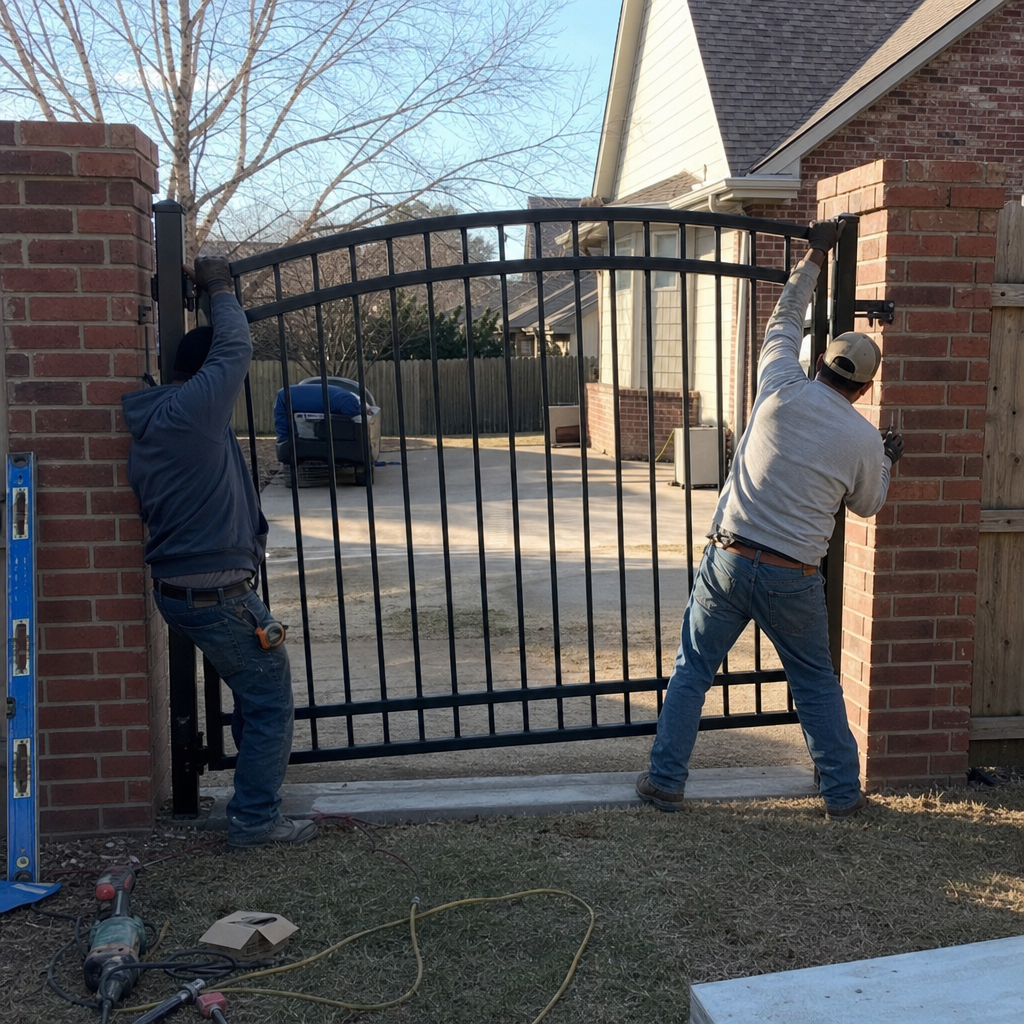
We learned this the hard way twenty years ago. A customer in the Westheight Manor neighborhood—where Douglas grew up—had called three companies for a swing gate quote. Two gave her a flat price over the phone. The third, a fencing contractor, showed up and discovered her driveway dropped six inches across a twelve-foot span. That “standard” swing gate would have dragged open every morning until the posts worked loose in the clay-heavy Kansas soil. She ended up with us, not because we were cheapest, but because we were the only ones who asked about the slope before talking about the gate.
Why the Ground Under Your Gate Matters More Than the Gate Itself
Kansas City sits on some of the most expansive clay soils in the Midwest. The Kansas Geological Survey has documented shrink-swell potential in Wyandotte and Johnson Counties that can move fence posts and gate footings by inches seasonally. Most installation cost guides treat soil as an afterthought. In our experience, it’s often the first thing that determines whether your gate works properly in year three—or whether you’re calling for a repair because the posts have tilted and the gate is binding.
Here’s what we check before we quote:
- Soil composition and drainage: Heavy clay holds water and heaves in freeze-thaw cycles. We pour deeper footings—sometimes 36 inches rather than the standard 24—and use wider base plates to distribute load. That extra concrete and labor adds $400–$900 to a typical residential job.
- Grade change across the opening: A driveway that slopes more than 2 inches over the gate width forces hard decisions. Swing gates need level mounting, so we either grade and retain (expensive) or switch to a slide gate (different price structure entirely). We’ve seen general contractors install swing gates on sloped drives and walk away; the customer calls us six months later when the gate won’t latch.
- Distance from electrical panel to gate post: Running 110V or low-voltage control wire across a long driveway—common on the larger lots in older KCK neighborhoods like Rosedale or Argentine—can add $800–$2,200 depending on trenching depth, conduit requirements, and whether we hit buried utilities. Solar operators exist, but Kansas winters and tree canopy make them unreliable for primary power on many sites.
- Existing fence or pillar condition: A gate needs something solid to close against. Wobbly existing posts, deteriorating brick pillars, or mismatched fence lines mean we’re building structure before we hang a gate. We’ve fabricated steel posts to match existing wrought iron and welded receiver brackets to crumbling masonry when full rebuild wasn’t in the budget.
These aren’t edge cases. In the 1940s–1970s residential stock that dominates Kansas City’s older corridors, irregular lot lines and non-standard setbacks are the norm. A “standard” 16-foot gate doesn’t fit a 14-foot-6-inch opening with a utility easement biting into one side. General contractors mark that up as “custom.” We measure, fabricate in-house, and install at our standard rates because that’s what two decades of gate-only work has taught us to expect.
Swing vs. Slide: A Cost Fork, Not Just a Preference
Most homeowners start with a picture in their head: a gate that swings open like something from a country estate. The driveway often has other plans.
A swing gate needs level ground, adequate swing radius clear of obstacles, and posts that don’t move. Installation runs $2,800–$5,500 for a typical residential aluminum or steel single swing with a standard operator like a LiftMaster or Elite system. Double swing gates—two leaves meeting in the middle—run $3,800–$7,000 but require precise synchronization and more robust posts.
When the grade drops, the driveway curves tightly, or parking space is limited inside the gate line, a slide gate becomes the practical choice. The hardware costs more—track, rollers, and a more powerful operator—and the installation requires perfectly level track embedding. Typical residential slide gate installation in Kansas runs $4,200–$7,500. But it’s the right choice when a swing gate would scrape asphalt or require impractical clearances.
We’ve had customers in the Turner neighborhood insist on swing gates despite a 4-inch drop. We don’t install those. Douglas’s rule: “Tell me what it’s doing—and what it was doing right before that. That’s usually where the answer is.” Applied to installation, that means reading the site conditions honestly and recommending what will work, not what the customer pictured first.
| Installation Component | Low Range | High Range |
|---|---|---|
| Manual swing gate (no operator) | $1,800 | $3,200 |
| Single swing gate with standard operator | $2,800 | $5,500 |
| Double swing gate with dual operators | $3,800 | $7,000 |
| Slide gate with track and operator | $4,200 | $7,500 |
| Extended electrical run (per 50 ft) | $800 | $2,200 |
| Deep footing/retention for clay soil | $400 | $900 |
| Custom width fabrication (in-house) | $0 | $350 |
| Access control (keypad, remote, intercom) | $450 | $1,800 |
Note: Our custom width fabrication is priced at standard rates because we do it in-house. Competitors who outsource fabrication typically add $600–$1,200 for non-standard sizes.
The Operator Brand Mistake That Costs You Twice
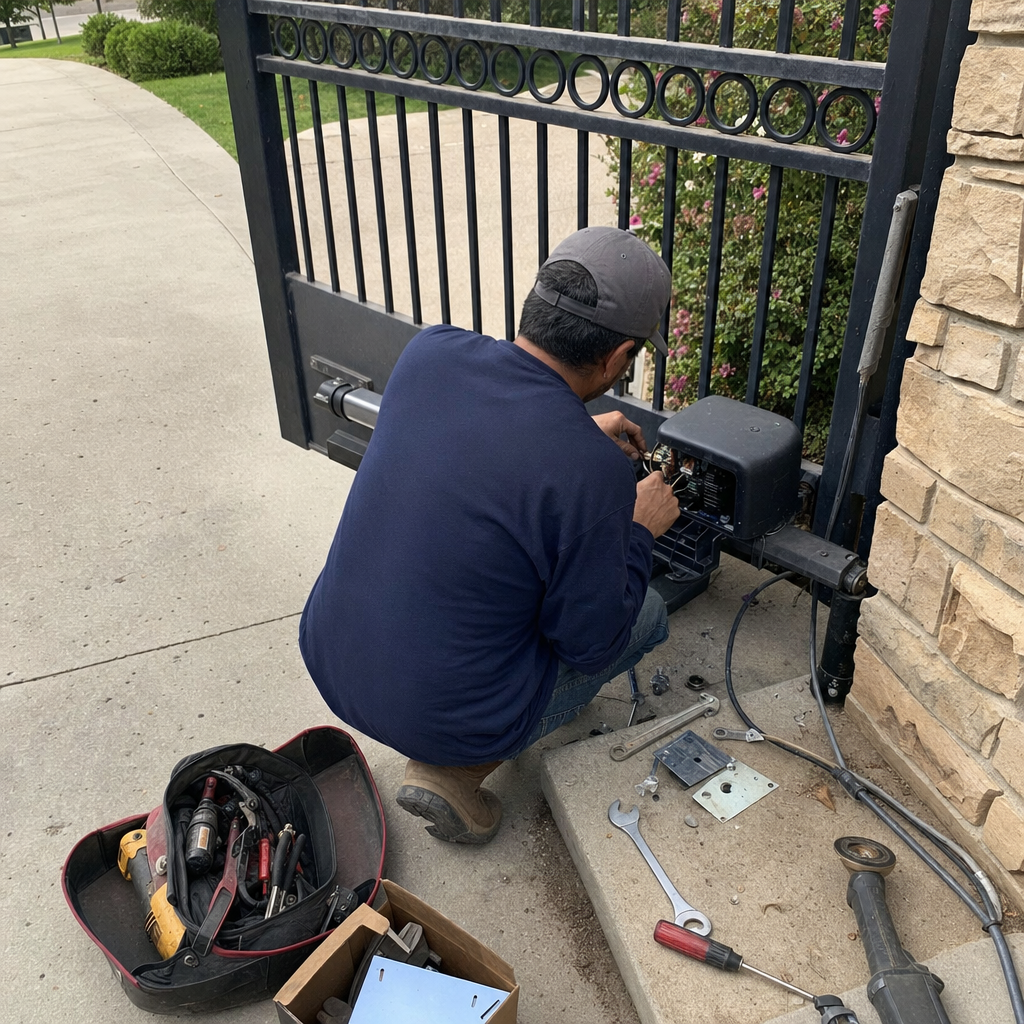
Here’s something we see regularly: a general contractor or fencing company installs a Mighty Mule residential operator on a heavy steel gate because it’s available at the supply house and the margin is decent. Eighteen months later, the gears are stripped and the customer is calling us for a repair that costs nearly what the installation did.
Gate operators are matched to gate weight, cycle frequency, and wind load—not just “residential” versus “commercial.” A solid steel gate in Kansas catches prairie wind that an aluminum gate doesn’t. A FAAC or LiftMaster commercial-duty operator costs more upfront but runs for years without the intermittent faults that send homeowners searching for help.
Douglas tracks down those intermittent electrical faults because he’s seen them before—across nine major brands, in every neighborhood from Piper to Strawberry Hill. When he visits your site before quoting, he’s not just measuring. He’s weighing the gate in his head, checking wind exposure, and deciding whether your usage pattern justifies a heavier-duty operator than the catalog suggests. That’s the difference between a gate that works and a gate that “works for now.”
What Kansas City’s Older Housing Stock Means for Your Quote
The lots built out in KCK between the 1940s and 1970s weren’t designed for automatic gates. Setbacks vary block by block. Alley access complicates slide gate track placement. Original concrete driveways are thin by modern standards and won’t support embedded track without reinforcement or replacement.
We’ve installed gates in Rosedale where the available width was 13 feet 4 inches—nowhere near a standard catalog size. A fencing company would order custom and mark it up. We measured, cut, and welded the gate in our shop, then hung it with standard hardware. The customer paid for a standard gate because our in-house fabrication capability absorbed what others outsource.
Same story in Argentine, where we’ve reinforced existing brick pillars with steel inserts rather than rebuilding from scratch. And in Westheight Manor, where Douglas grew up, we’ve routed electrical through established landscaping to avoid trenching mature trees that the neighborhood values.
These aren’t heroic exceptions. They’re what happens when a gate specialist—not a generalist—does the work. Two decades of gate-only experience means we’ve seen your exact conditions before, even if your driveway is unique.
Key Takeaways: What Actually Drives Your Installation Cost
- Site conditions beat catalog prices every time. Soil, grade, electrical access, and existing structures determine the real scope.
- Swing vs. slide isn’t aesthetic preference. It’s a functional decision that changes your entire price structure and long-term reliability.
- Operator matching matters. The wrong brand or duty rating for your gate weight and wind load means a repair call inside two years.
- Custom widths are standard for us. In-house fabrication means irregular lot lines don’t trigger custom pricing.
- Site visit before quote is non-negotiable. Any number given without seeing your driveway is unreliable.
FAQs
Driveway gate installation in Kansas, KS typically costs between $2,800 and $7,500 for a standard residential setup with operator, though simple manual gates can run as low as $1,800 and complex installations with grade challenges or long electrical runs can exceed $12,000. The final price depends heavily on your driveway’s slope, soil conditions, and distance from electrical service. Call (833) 754-6310 for a free site visit and exact quote—Douglas Ross measures before pricing, never after.
Swing gates generally cost less to install—typically $2,800–$5,500 versus $4,200–$7,500 for slide gates—but only if your driveway is relatively level and has adequate swing clearance. On a sloped driveway, a swing gate requires grading or retaining work that often makes a slide gate the more economical and reliable choice overall. We’ve declined swing installations when the site conditions would have guaranteed future problems; the cheapest initial quote isn’t the cheapest lifetime cost.
Yes, but usually with a slide gate rather than a swing gate, since swing gates require level mounting and adequate clearance arc that sloped drives rarely provide. For moderate slopes, we sometimes grade and retain the gate area; for steeper grades, we recommend slide gates with embedded track, which adds $1,200–$2,500 to typical installation but functions reliably long-term. Every sloped driveway we’ve worked in Kansas City’s clay soil has required deeper footings to prevent post shift—something we assess during our pre-quote site visit.
Most residential driveway gate installations in Kansas take one to three days, with day one for excavation, footing pours, and electrical rough-in, and day two for gate hanging, operator mounting, and testing. Jobs requiring extended trenching, custom fabrication, or concrete curing in cold weather can extend to four or five days. We don’t rush the footing cure—gates fail when posts move, and Kansas freeze-thaw cycles punish shortcuts. Call (833) 754-6310 to schedule a site visit; we’ll give you a realistic timeline based on your actual conditions, not a standard template.
Ready for a Quote That Reflects Your Actual Driveway?
We’ve been installing and repairing gates across Kansas City for twenty years. Douglas Ross takes the call and does the work—the owner is your technician. Gate Installation is what we focus on exclusively, and we service 9 major brands so your system is never out of scope. When a part isn’t available, we fabricate it in-house. Our 413 customers and 4.9-star average didn’t happen by accident; they happened one honest job at a time.
Call (833) 754-6310 today for a free, no-obligation site visit and written estimate. We’ll walk your driveway, read your conditions, and give you a number that means something.
Written by Douglas Ross, Owner & Lead Technician at Halcyon Automatic Gate Repair Kansas, serving Kansas, KS.