How Does an Automatic Gate Opener Work in Kansas, KS?
An automatic gate opener is a closed-loop control system: a signal from a remote, keypad, or vehicle detector tells the control board to start the motor, while feedback sensors—limit switches, encoders, and torque monitors—continuously report position and resistance back to that same board, which decides when to stop, reverse, or hold based on programmed safety rules. In Kansas, where summer thunderstorms and winter ice storms knock out power several times per year, understanding whether your operator runs on AC line power or DC battery backup directly affects whether your gate becomes a manual liability when the grid fails. If your gate is opening but not closing, or reversing for no visible reason, the safety interlock layer—not the motor—is almost always the component trying to tell you something. Call (833) 754-6310 and we’ll walk through what you’re seeing; often we can narrow it to one of three causes before we even roll a truck.

Why Most “Broken” Gates Are Actually Working Exactly as Designed
Here’s the framing that saves our customers in Kansas City, Kansas, both money and frustration: a gate opener doesn’t just open gates. It’s engineered to fail safely, and most of the calls we get—especially after storms, after a bump from a delivery truck, or after years of vibration loosening hardware—are the safety system doing precisely what it’s supposed to do in response to a real, detectable problem.
Douglas Ross, our owner and lead technician, puts it plainly: “Tell me what it’s doing — and what it was doing right before that. That’s usually where the answer is.” Over 20 years of gate-only work in this community, he’s found that the gate owner who understands the interrupt logic—the dozen ways the system can stop itself—becomes the gate operator who spots trouble before it becomes a $400 emergency call.
The typical homeowner in neighborhoods like Westheight Manor, where Douglas grew up, or the newer developments out near Piper, assumes the motor is the brain. It isn’t. The motor is the muscle. The control board is the brain, and its primary job isn’t motion—it’s managing the conditions under which motion is permitted to continue.
The Full System Loop: From Signal to Stop
Most online explainers stop at “you press the button, the gate moves.” That description misses the feedback architecture that makes automatic gates safe enough for residential use. Here’s what actually happens, in sequence, every time your gate cycles:
- Signal input: A remote fob, keypad code, loop detector, phone app, or intercom sends a request to the control board. Each input type has a different priority level—emergency vehicle loops override residential remotes, for instance.
- Control board processing: The board checks current state (is the gate already moving? is a safety sensor reporting obstruction? is the photo-eye beam interrupted?). If all interlocks clear, it authorizes motor activation.
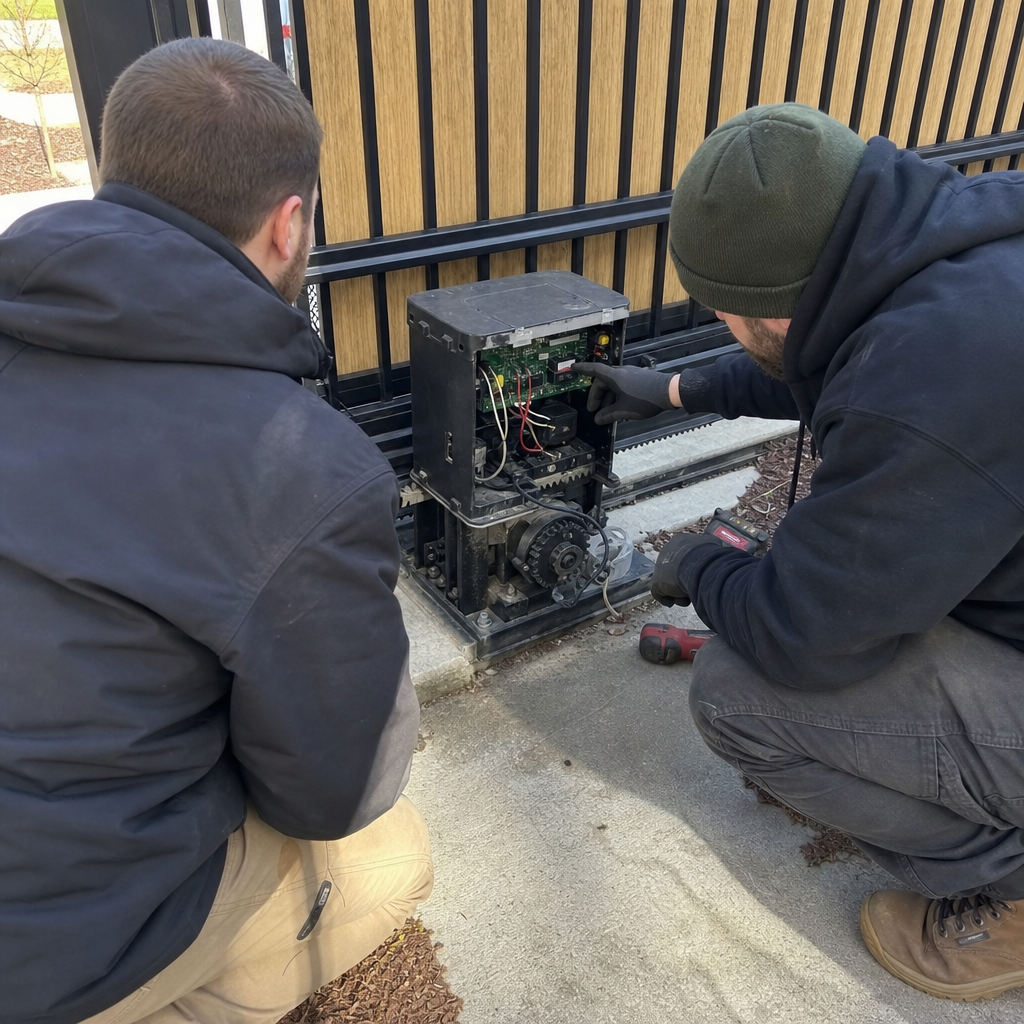
- Motor actuation: The drive system engages—either a linear actuator for swing gates or a rack-and-pinion or chain drive for slide gates. AC-powered operators (common in commercial Kansas installations) deliver higher torque and duty cycle; DC battery-backed operators (standard in residential systems, including most Mighty Mule and Ghost Controls units we service) run quieter and continue operating during outages.
- Feedback monitoring: While the gate moves, the board receives continuous data from limit switches (position endpoints), rotary encoders (speed and distance), and torque sensors (resistance load). If torque spikes—say, a child runs toward a closing gate, or ice jams the track—the board reverses or stops within fractions of a second.
- Arrival and hold: At the programmed limit, the motor brakes and holds. Some operators, like the LiftMaster LA500 series we install frequently, include a soft-start/soft-stop ramp to reduce mechanical stress on heavy iron gates common in older Kansas City homes.
That feedback loop is why a gate that opens fine but won’t close is almost never a motor problem. The board is receiving a signal—usually from a safety sensor—that says “unsafe to proceed,” and it’s honoring that signal. Finding which sensor, and why it’s triggering, is the diagnostic work.
The Safety Interlock Layer: Where Most Confusion Lives
Kansas homeowners call us most often about three specific failure patterns, all of them originating in the safety layer rather than the drive system:
Photoelectric beams: These infrared sender-receiver pairs mount across the gate opening, typically 6-12 inches above ground. If the beam breaks during closing, the gate reverses immediately. In Kansas, where freeze-thaw cycles shift post foundations and where summer humidity fogs lenses, beam misalignment is the single most common cause of “opens but won’t close” complaints. A beam that’s off by even 3 degrees—barely visible to the eye—reads as a constant obstruction.
Obstacle detection / pressure reversal: Modern operators, including most DoorKing and Elite models we work on, include current-sensing circuits that monitor motor load. If resistance exceeds a calibrated threshold—contact with a vehicle bumper, a bicycle, a pet—the board reverses. These thresholds drift out of calibration over years of use, especially on gates with sagging hinges that already load the motor unevenly.
Loop detectors: In commercial and HOA installations throughout Kansas, especially near the Legends Outlets area and along Interstate 70 corridor properties, embedded pavement loops detect vehicles by magnetic induction. These behave fundamentally differently from remote systems: they activate on presence, not command, and they tie into the board through a separate detector module. A loop with a cracked wire (common after Kansas City’s aggressive freeze-thaw cycles) causes intermittent detection—gate opens for no apparent reason, or ignores vehicles entirely.
We’ve serviced properties in KCK where the previous contractor replaced an entire Gate Motor & Opener when the actual fault was a $12 loop detector module. That’s the diagnostic depth 20 years of gate-only experience buys you.
AC vs. DC Operators: What Kansas Weather Means for Your Choice
The power architecture of your operator isn’t just a technical detail—it directly affects reliability during the weather events that define Kansas living.
| Characteristic | AC-Powered Operators | DC Battery-Backed Operators |
|---|---|---|
| Power source | Direct 110V/220V line | Low-voltage DC with battery backup |
| Duty cycle | Continuous (100+ cycles/hour) | Intermittent (typically 20-30 cycles/hour) |
| Typical application | Commercial, multi-family, high-traffic HOA | Residential single-family |
| Storm outage behavior | Dead without generator backup | 50-100 cycles on battery; solar-compatible |
| Brands we service | FAAC, BFT, DoorKing, LiftMaster commercial | Mighty Mule, Ghost Controls, Linear, Viking |
| Approximate installed range in Kansas market | $2,800–$5,500 | $1,400–$2,800 |
For Kansas homeowners in areas with frequent outages—parts of Wyandotte County and rural Johnson County especially—we often recommend DC systems with solar panel add-ons. The payback isn’t just financial; it’s operational continuity when your gate is your primary security perimeter. For commercial properties with 24-hour traffic, AC remains the standard, but we specify battery-backed control boards as failover where the application allows.
Common Local Scenarios We See in Kansas
Every market has its pattern of gate failures. In Kansas, after two decades of calls, ours are distinct enough that we can often predict the cause from the address:
Post-storm intermittent operation: After a typical Kansas spring storm with 60mph winds and lightning, we see a wave of calls from Piper, Turner, and Argentine neighborhoods. The pattern is almost always surge damage to the control board or water infiltration into underground conduit feeding the loop detector. The gate works fine in dry conditions, fails unpredictably after rain. We trace these with a megohmmeter on the loop circuit and board-level voltage analysis—tools generalist contractors rarely carry.
Iron gate hinge sag on pre-1950s homes: Westheight Manor and Rosedale have beautiful wrought-iron gates that have survived a century. The operators haven’t. When a heavy iron gate sags on corroded hinges, the motor torque sensor reads constant overload and either refuses to start or reverses immediately. We’ve fabricated custom hinge pins and brackets in our shop to correct the mechanical problem without replacing historic gates that shouldn’t be discarded.
HOA slide gate track debris: Properties near the Kansas River, especially in low-lying developments, get silt and gravel wash into V-groove tracks. The gate still moves—until it doesn’t, usually on the coldest morning of winter when contraction tightens clearances. Our preventive maintenance calls for these properties include track cleaning, lubrication with cold-rated grease, and limit switch verification.
Keypad failure after temperature swings: Keypads mounted on metal posts experience wider temperature extremes than the ambient air. We see membrane switch failures and LCD ghosting on units exposed to direct afternoon sun, then rapid evening cooling. When we replace these, we spec vandal-resistant housings with internal heating elements for exposed Kansas installations.
What You Can Check, and What You Shouldn’t
There are safe owner-level checks that help us diagnose faster when you call, and there are tasks that genuinely risk injury or further damage.
Safe to check: Verify photoelectric beam alignment (most units have LED indicators—steady green means aligned, flashing or red means blocked or misaligned). Confirm no physical obstruction in the gate path. Check that the manual release hasn’t been left disengaged (a common post-power-outage oversight). Note whether the problem is consistent or intermittent, and whether it correlates with weather or time of day.
Leave to us: Any work on high-tension spring-assisted operators (found on some heavy commercial slide gates), electrical troubleshooting inside the control box, or recalibration of safety force settings. These carry real injury risk and, on commercial installations, liability exposure if not documented properly.
Our in-house fabrication and welding capability matters here too. When a track bracket shears or a hinge pin wears eccentric, we’re not waiting on parts that may be obsolete. We measure, cut, and weld the replacement in our shop, often same-day. That’s how a gate that “needs full replacement” becomes a gate that needs a $200 repair.
FAQs
The safety interlock system is detecting an obstruction or misalignment that only affects the closing cycle, most commonly a misaligned photoelectric beam, a triggered edge sensor, or a loop detector reporting constant vehicle presence. Check your photo-eye LEDs for steady green alignment; if they’re flashing or red, realign the receiver until they stabilize. If the indicators look correct, the fault may be in the wiring or the board’s interpretation of the signal—call (833) 754-6310 and we’ll sort it without replacing parts speculatively.
Most residential gate opener repairs in the Kansas market fall between $180 and $450, with simple sensor realignments or keypad replacements at the lower end and control board replacement or motor rebuilds at the higher end; commercial AC operator repairs typically range $350 to $850 depending on access requirements and parts availability. We provide upfront pricing after diagnosis, not before—we’ve seen too many customers in KCK pay for “estimated” work that ballooned. Estimates are free, and we’ll show you exactly what failed and why.
Only if you have a DC battery-backed operator or a separate battery backup system installed; standard AC operators stop functioning entirely when line power fails, though all operators include a manual release for emergency operation. In Kansas, where outages from thunderstorms and ice events are predictable seasonal risks, we evaluate battery backup or solar compatibility on every residential quote. If your current system is AC-only, retrofit options exist for most major brands including LiftMaster and Linear.
A quality residential gate opener properly maintained should deliver 10-15 years of service, while commercial AC units in high-cycle applications typically see 7-10 years before major component replacement; the actual lifespan in Kansas depends heavily on preventive maintenance, given our freeze-thaw cycling and summer UV exposure. Gates we service annually—lubrication, limit verification, safety force testing, hardware torque-checking—routinely outlast neglected systems by 5+ years. If yours is approaching a decade and showing intermittent quirks, a maintenance call now usually prevents an emergency replacement call later.
When to Call Halcyon
If you’re tracing an intermittent fault, if your gate has started behaving differently after weather, or if you’ve already had one contractor suggest replacement and something about that feels premature, we’re the second opinion that often becomes the final repair. Douglas Ross takes the call and does the work—the owner is your technician. Two decades of gate-only experience means we’ve seen your exact problem before. We service 9 major brands, so your system is never out of scope. And when a part isn’t available, we fabricate it—our in-house welding capability keeps your gate from becoming a replacement project.
413 customers and a 4.9-star average don’t happen by accident—they happen one honest job at a time. If you’d rather have it looked at, Halcyon Automatic Gate Repair Kansas offers a no-pressure assessment in Kansas—call (833) 754-6310.
Written by Douglas Ross, Owner & Lead Technician at Halcyon Automatic Gate Repair Kansas, serving Kansas, KS.