DoorKing Gate Repair in Wichita: A Homeholder’s Guide
DoorKing gate repair in Wichita typically runs $280–$650 depending on whether you’re dealing with a board reprogramming, loop detector recalibration, or full operator replacement. Most DoorKing issues that look like hardware failures are actually programming or calibration problems — and a technician who knows the board architecture can tell the difference in minutes, not hours. If your gate is hesitating, cycling erratically, or ignoring keypad entries, Halcyon Automatic Gate Repair Kansas can diagnose it over the phone and often fix it same-day — call (833) 754-6310.
DoorKing equipment tends to fail quietly before it fails completely — a slight hesitation on cycle, a keypad entry that works on the third try, a loop detector that lets in every car except yours. Those are warnings, not quirks. In 20 years of gate-only work across Wichita, we’ve learned that DoorKing’s robust construction actually masks problems until they’re advanced, because the hardware keeps limping along while the control logic degrades. The homeowner who catches the early signal saves $200–$400 versus the one who waits for total failure.
The Early Warning Signs Every DoorKing Owner Should Recognize
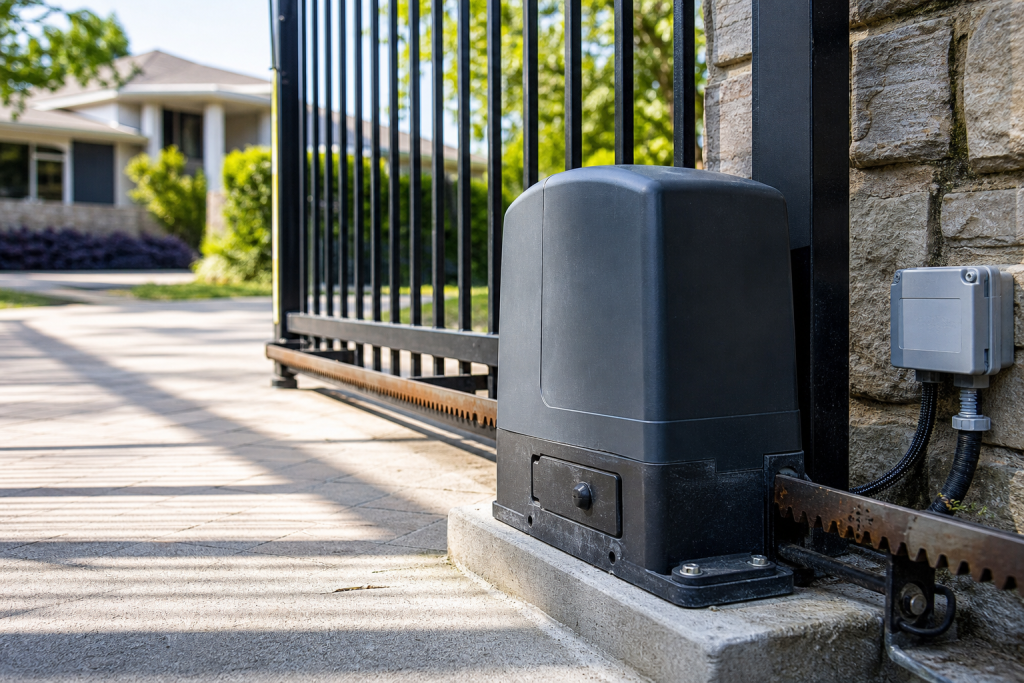
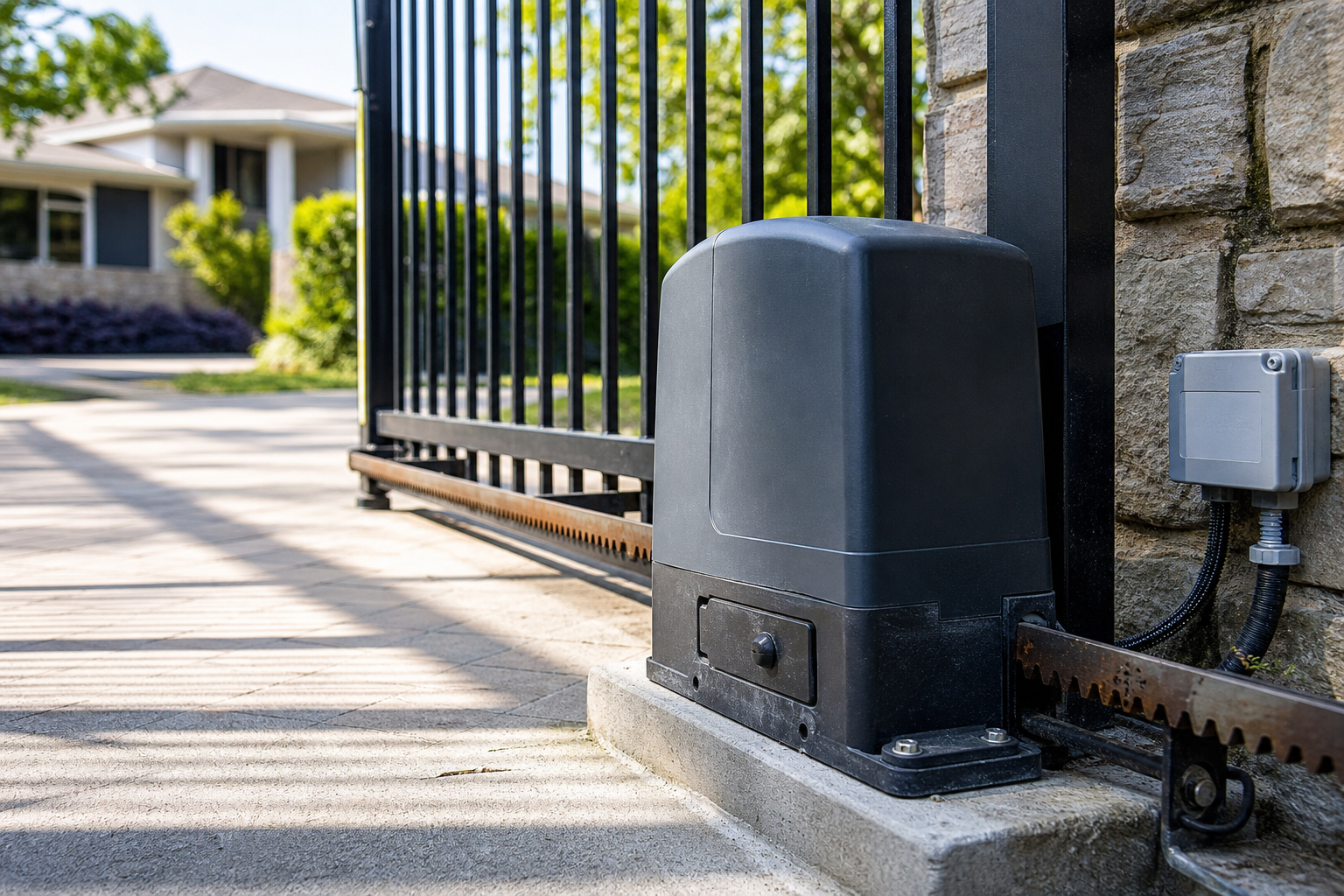
DoorKing systems — whether you’ve got a residential 1800-series swing operator or a commercial 1400-slide gate — communicate distress through behavior, not error codes. Here’s what we’ve documented across hundreds of service calls in Wichita, from Riverside estates to Haysville commercial yards:
- Cycle hesitation: The gate pauses 2–3 seconds mid-travel, then completes. This isn’t “thinking” — it’s usually the encoder losing position feedback, or the board’s soft-start ramp degrading.
- Keypad inconsistency: Entry codes work on the third try, or only in cool morning temperatures. This points to the 1812 or 1833 telephone entry system’s voltage regulator failing, not the keypad itself.
- Loop detector “ghosting”:strong> Your vehicle triggers the exit loop, but the gate won’t open until you back up and re-approach. Classic DoorKing loop detector sensitivity drift — exacerbated by Wichita’s freeze-thaw cycles heaving the asphalt around the saw-cut loop.
- Partial opening: Gate opens 18 inches and stops. Often misdiagnosed as mechanical binding; frequently it’s the board’s obstruction sensitivity threshold creeping upward from capacitor aging.
We serviced a unit over in College Hill last month where the homeowner had lived with “third-try keypad syndrome” for eight months. By the time we arrived, the voltage regulator had taken the main board with it. A $180 early fix became a $620 board replacement. The signs were there — they just weren’t loud enough.
Why DoorKing’s Board Architecture Creates Misdiagnosis Traps
DoorKing’s control boards — particularly the 9100 and 9150 series — use a proprietary event-queue system that stores operational parameters in non-volatile memory. When that memory corrupts (power surge, lightning strike, or simple age-related bit-rot), the board behaves exactly like a failed motor or seized gearbox. A generalist technician sees a gate that won’t move, assumes the operator is shot, and quotes $1,800 for replacement.
Here’s how we tell the difference in the field:
- Listen to the click pattern: A healthy DoorKing board produces a distinct relay sequence on power-up — three rapid clicks, pause, then a fourth. Corrupted boards often show two clicks, or five, or none. That’s diagnostic data, not random noise.
- Check the LED “heartbeat”: The status LED should flash at consistent 1-second intervals. Double-flashing, irregular timing, or solid-on indicates firmware or memory issues, not power supply failure.
- Test in manual override: If the gate moves freely by hand and the motor resistance is nominal (we check with a multimeter — should read 3–8 ohms across windings), the mechanical path is clear. The problem lives in logic, not metal.
In our experience, roughly 30% of “dead” DoorKing operators we encounter in Wichita are actually board reprogramming or memory-reset cases. The hardware’s fine — it just forgot how to be a gate. Douglas Ross takes the call and does the work, and that hands-on diagnosis is where the 20 years of gate-only experience pays off. We’ve seen your exact problem before, and we know which symptoms point where.
Loop Detector Calibration: The “Works Sometimes” Problem
DoorKing’s loop detector modules — especially the LD series paired with 1400 and 1600 commercial operators — are sensitive instruments in insensitive environments. Wichita’s clay-heavy soils and dramatic seasonal temperature swings (0°F January mornings to 105°F July afternoons) create constant expansion and contraction around the buried inductive loop. The loop wire itself rarely breaks; what changes is the loop’s inductance signature as the surrounding ground shifts.
The symptom is maddeningly inconsistent: your truck triggers the exit loop reliably at 7 AM, fails at 2 PM, works again after rain. Most homeowners assume the detector is failing and replace it — only to have the same problem recur.
What’s actually happening: the detector’s sensitivity threshold was calibrated to a specific inductance range. Ground movement changes that range by 10–30 microhenries. The detector isn’t broken; it’s correctly reporting that the loop signature no longer matches its programmed “open” threshold.
Proper fix: recalibrate the detector to the current loop signature, then set sensitivity with 15–20% headroom for seasonal drift. We also check for “phantom” detection — when the loop picks up adjacent rebar or underground utilities that shift position with frost heave. It’s tedious work that requires understanding DoorKing’s calibration protocol (hold PROGRAM, cycle through sensitivity levels while watching the LED color sequence), but it saves the cost of unnecessary detector replacement.
We pulled one out of a garage over in Delano last week where the previous company had replaced the loop detector twice in 14 months. Ground hadn’t changed; calibration had never been performed correctly. Two decades of gate-only experience means we’ve seen your exact problem before.
Repair Versus Replace: When the Math Shifts
DoorKing builds for longevity — 15–20 year service life isn’t unusual with proper maintenance. But board economics have changed. As of 2024–2025, several legacy DoorKing control boards (9100-080, 9150-114, early 1812 entry system mainboards) have crossed a cost threshold where replacement parts approach 60–70% of a new operator’s installed price.
| Scenario | Typical Repair Range | Replacement Installed | Our Recommendation |
|---|---|---|---|
| Board reprogramming / memory reset | $180–$280 | $1,400–$2,200 | Repair — 10-minute fix, full function restored |
| Single board component failure (relay, capacitor) | $280–$450 | $1,400–$2,200 | Repair if board is current-generation; evaluate age |
| Full board replacement, legacy 9100 series | $620–$850 | $1,600–$2,400 | Replace — new operator carries warranty, modern safety features |
| Loop detector + recalibration | $220–$340 | N/A (component only) | Repair — detector rarely fails, calibration usually suffices |
| Motor winding failure on 15+ year operator | $480–$720 | $1,400–$2,200 | Replace — motor failure signals systemic wear |
The decision point isn’t just dollars — it’s future supportability. DoorKing supports current-generation boards for 10+ years, but legacy stock is diminishing. When we evaluate a system in Wichita, we check: operator age, cycle count (commercial units log this), parts availability, and whether the existing safety devices (photo eyes, edge sensors) meet current UL 325 standards. Sometimes a $400 repair is the smart money; sometimes it postpones an inevitable $1,800 spend by 18 months, and we’d rather tell you that upfront.
We service 9 major brands, so your system is never out of scope — but we’re also not going to sell you a repair that doesn’t make sense. 413 customers and a 4.9-star average don’t happen by accident; they happen one honest job at a time.
What to Document (and What Not to Touch) Before Calling
If your DoorKing system is malfunctioning, the actions you take in the next 10 minutes can either preserve diagnostic options or erase them. Here’s the protocol we give Wichita homeowners:
Document immediately:
- Exact symptom sequence — “gate opened 2 feet, paused, reversed” is more useful than “it doesn’t work”
- LED status at time of failure (color, flash pattern, solid)
- Whether the problem is consistent or intermittent, and any temperature/time patterns
- Recent power events — storms, outages, construction nearby
- Model numbers from the operator nameplate (usually inside the cover, upper right)
Do not touch:
- The PROGRAM or RESET buttons on the board — these erase event logs and calibration data we need for diagnosis
- Dip switches — DoorKing uses these for configuration, and random changes create compound problems
- Loop detector sensitivity knobs — if you guess wrong, you can desensitize the loop entirely, making the “works sometimes” problem into “works never”
- Mechanical limit switches — these are factory-set to encoder position; manual adjustment throws off the entire travel profile
The event log in a DoorKing 9150 board stores the last 250 cycles with fault codes. That log is a goldmine — unless someone hit RESET. When Douglas Ross arrives on a job, that data often tells us more than visual inspection. Preserve it.
When to Call a Pro
If you’ve documented symptoms and the gate still won’t cycle reliably, it’s time. DoorKing systems operate at 24V DC control voltage with 120V AC mains present — not lethal territory, but the high-torque mechanical components (particularly on commercial 1400-series slide gates) can cause serious injury if the operator energizes unexpectedly during troubleshooting. Beyond safety, the diagnostic tools — oscilloscope for loop signature analysis, proprietary programming software for board-level work — aren’t homeowner equipment.
When a part isn’t available, we fabricate it — our in-house welding capability keeps your gate from becoming a replacement project. That’s the difference between a gate specialist and a general handyman.
Related services in Wichita: Gate Repair in Kansas City | Gate Installation in Kansas City | Gate Motor & Opener in Kansas City
The Bottom Line
DoorKing systems reward informed ownership. The quiet failure pattern that frustrates many Wichita homeowners is actually a feature of robust hardware — the gate keeps working while the control logic degrades, giving you warning time if you know the signals. Hesitation, inconsistent keypad response, and loop detector ghosting are your early alerts. Board misdiagnosis is the most expensive mistake, because it leads to unnecessary replacement when reprogramming or recalibration would restore function. Document before you touch anything, and when the problem exceeds your comfort zone, call someone who knows the board architecture cold.
If you’re in Wichita and need help, Halcyon Automatic Gate Repair Kansas offers free estimates — call (833) 754-6310. Douglas Ross takes the call and does the work.
Frequently Asked Questions
Most DoorKing repairs in Wichita fall between $280 and $650. Simple board reprogramming or loop detector recalibration runs $180–$340, while board replacement on older 9100-series operators can reach $620–$850. Full operator replacement, when warranted, typically installs at $1,600–$2,400. Call (833) 754-6310 for an exact quote — estimates are free.
Intermittent keypad response usually indicates voltage regulator degradation in the telephone entry system’s mainboard, not keypad failure. The regulator delivers unstable voltage to the keypad scan circuit, causing missed or delayed key registration. Temperature sensitivity — works in morning, fails in afternoon heat — is the telltale sign. This is repairable at board level if caught before regulator failure cascades to other components.
Yes — for most programming, calibration, and component-level issues, we carry common DoorKing parts and diagnostic tools on our service vehicle. Same-day availability depends on symptom complexity and parts required; legacy board replacements sometimes need 24–48 hour shipping. Call (833) 754-6310 before noon for best same-day scheduling.
Repair makes sense when the fix is under 40% of replacement cost and the operator has remaining service life — typically under 12 years with moderate cycle counts. Replace when board replacement exceeds 60% of new-operator price, when safety devices no longer meet current UL standards, or when parts availability is uncertain. We evaluate each system individually in Wichita and give straight math, not sales pressure.
Written by Douglas Ross, Owner & Lead Technician at Halcyon Automatic Gate Repair Kansas, serving Wichita since 2006.
Need Gate Repair Help?
Call Halcyon Automatic Gate Repair Kansas — licensed & insured, here with fast after-hours help in Kansas.
(833) 754-6310