
Emergency Gate Repair Near Me: What Wichita Homeowners Should Do First
When your automatic gate fails in Wichita, the first ten minutes determine whether you’re looking at a simple service call or a costly secondary repair. Stop moving the gate immediately, check for obvious obstructions or power issues, and locate your operator’s manual release — but don’t force anything if it resists. If you’d rather not troubleshoot, call Halcyon at (833) 754-6310 and we’ll walk you through it or head your way.
Here’s a mistake we see constantly in Wichita: a swing gate stops mid-cycle after the motor trips, and the homeowner grabs the gate to push it the rest of the way open. That single motion can shear a mounting bracket, strip a gear, or snap a chain — turning a $150 reset-and-adjust call into a $600 bracket-and-arm replacement. The gate stopped because a safety sensor, limit switch, or thermal overload told it to stop. That reason is still active, and your muscle won’t override it safely.
After twenty years of gate-only work in Wichita, we’ve learned that most “emergencies” fall into two categories: genuine emergencies (gate trapping a person or vehicle, active security breach, gate blocking emergency access) and urgent inconveniences (gate won’t open for your morning commute, remote stopped working, keypad unresponsive). The response differs, and so does the cost. This guide covers what to do in those first critical minutes — and what to leave alone so a technician can actually fix the root problem.
Step 1: Stop and Assess Before You Touch Anything
The diagnostic information your gate has generated is perishable. Every button press, power cycle, or forced movement can erase the error code or fault state that would tell a trained technician exactly what failed.
Here’s what to check first, in order:
- Visual sweep: Look for physical obstructions — a rock wedged in the track, a branch caught in the arm, a vehicle bumper blocking the photo eye. Wichita’s wind patterns and mature tree canopy in neighborhoods like Riverside and College Hill mean debris-related stops are common, especially after storms.
- Power check: Is the operator’s LED indicator on? Are other outlets on the same circuit working? We’ve responded to “dead gate” calls in Wichita where the issue was a tripped GFCI outlet from recent rain — a two-minute fix.
- Listen: Does the motor hum or click when you press the remote? A humming motor with no movement suggests a mechanical bind; silence suggests electrical failure.
- Check remotes and keypads: Try a second remote or the wired wall button. If the wall button works but remotes don’t, you’ve narrowed it to RF or antenna issues, not the operator itself.
What you should not do yet: hit the reset button repeatedly, disconnect and reconnect power multiple times, or force the gate manually. Each of these actions can clear the fault log or cause additional mechanical damage.
Step 2: How to Safely Release Your Gate Manually
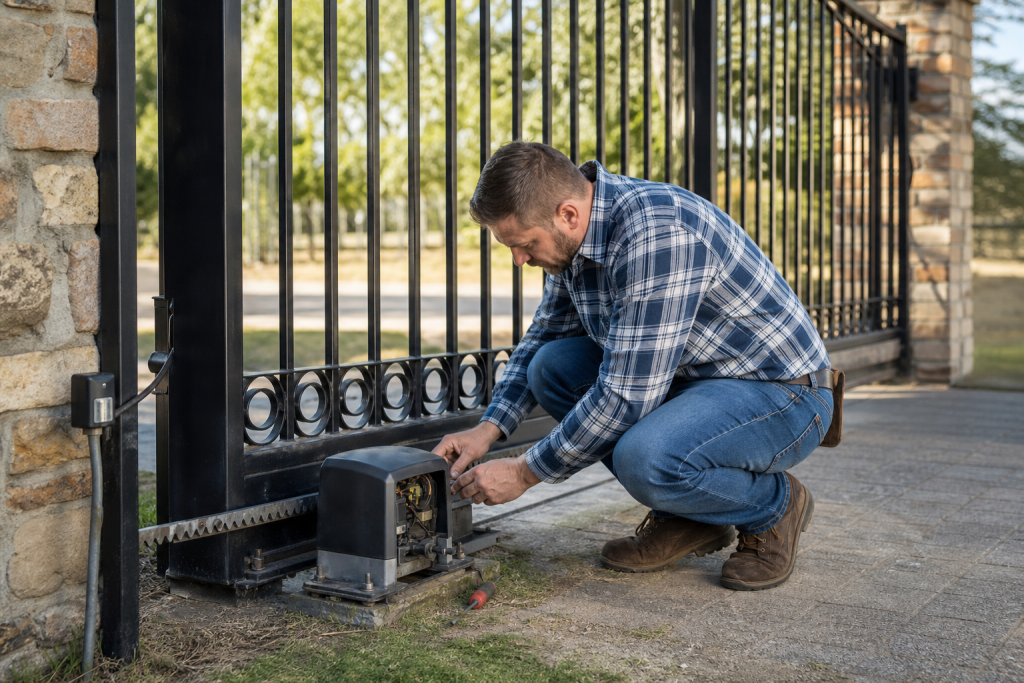
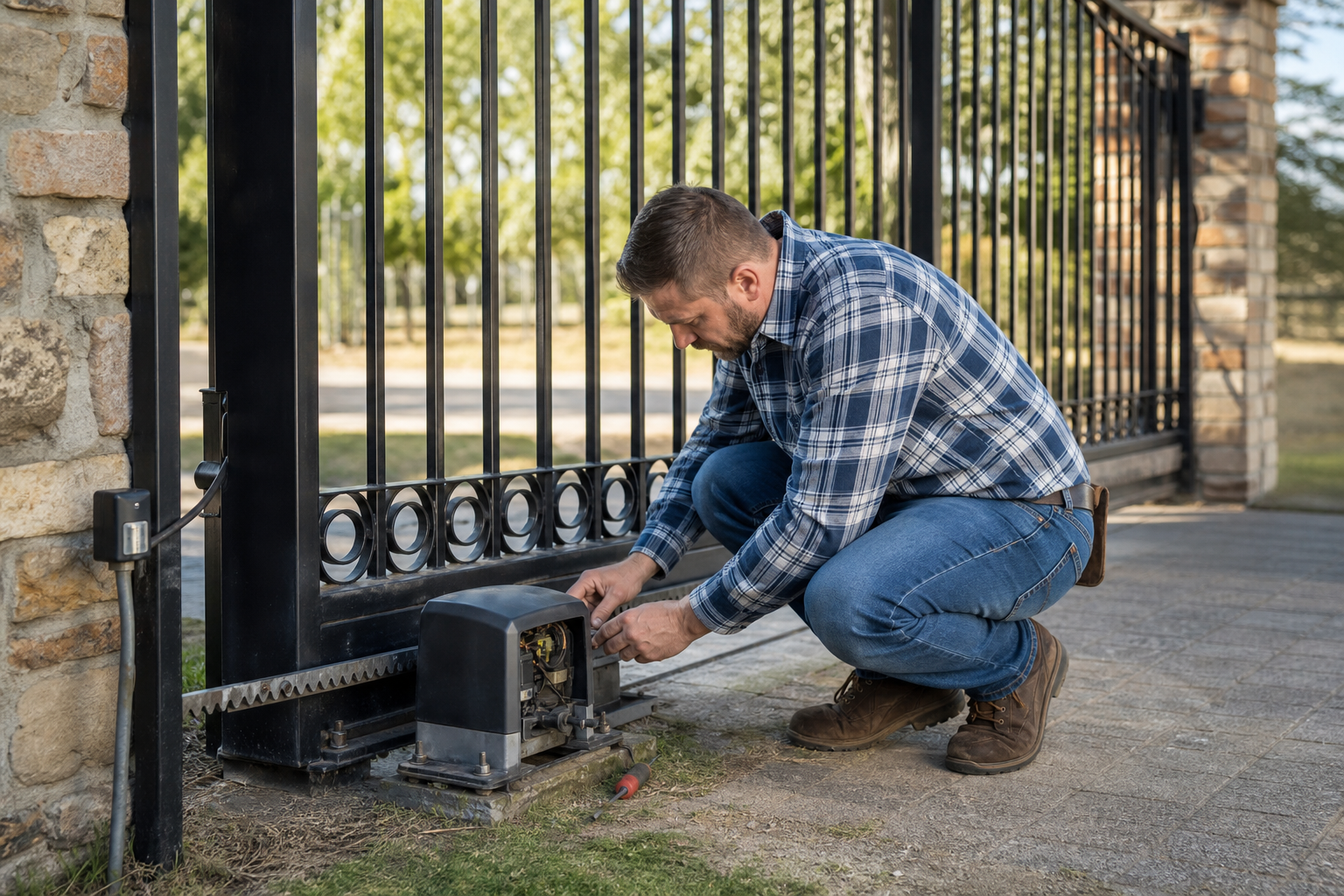
Most residential operators have a manual release — typically a key switch, pull handle, or lever — designed to disengage the motor and let you move the gate by hand. Using it correctly matters: improper release can damage the operator’s internal clutch or leave the gate in an unsafe freewheel state.
Common release types we encounter in Wichita:
- Chain-driven slide gates (LiftMaster, DoorKing, Elite): Look for a keyed release on the motor cover or a pull cable. Turn or pull firmly — you’ll feel a mechanical clunk as the clutch disengages. The gate should then move with moderate resistance from the chain weight.
- Articulating arm swing gates (FAAC, BFT): These often have a release lever on the operator body. Support the gate before releasing — the arm holds significant leverage, and an unsupported gate can slam closed or drop unexpectedly.
- Linear screw or ram operators (Linear, Viking): Typically a key release that disconnects the drive nut. These require more force to move manually; if it feels locked solid, double-check you’ve fully released the mechanism.
- DIY-friendly brands (Ghost Controls, Mighty Mule): Usually a simple pull handle or twist release, clearly labeled. These are designed for homeowner operation, but the same safety rules apply.
Safety note: If your gate is a heavy iron or steel unit — common in older Wichita neighborhoods like Delano and Midtown — manual movement requires two people. A 400-pound gate on a slope can accelerate faster than you can control, and crushed fingers or worse are real outcomes we’ve seen. When in doubt, secure the area and wait for a professional.
After release, the gate should move smoothly through its full range. Binding, grinding, or catching suggests a mechanical issue (track damage, hinge failure, wheel seizure) that forced the electrical shutdown in the first place. That’s not a DIY fix.
Step 3: Preserve the Diagnostic Information
When you call a gate repair contractor in Wichita, the most helpful thing you can say isn’t “it’s broken” — it’s “the operator showed error code 3” or “it stopped at exactly the same point three times, then the motor smelled hot.”
Here’s what erases that information:
- Repeated power cycling: Many operators clear fault logs after three power cycles. If you’ve already unplugged it “to see if that helps,” you’ve likely lost the error history.
- Factory resets: Never perform a factory reset unless instructed by a technician who has diagnosed the issue. Resetting restores default limits, force settings, and learned positions — essentially creating new problems on top of the original failure.
- Forced manual operation without release: Straining against a locked clutch can strip internal gears, making the original fault harder to identify and adding mechanical damage to the repair list.
If you’ve already done any of these, just tell the technician upfront. “I already tried resetting it” isn’t embarrassing — it’s diagnostic context. It tells us to approach the troubleshooting differently, and it prevents wasted time recreating steps you’ve already taken.
Step 4: Determine If This Is a True Emergency
Not every gate failure requires after-hours rates or emergency dispatch. Here’s how we categorize calls in Wichita:
Genuine emergencies — call immediately, any hour:
- Gate has trapped a person or vehicle
- Gate is stuck open, creating active security exposure for a commercial property or residence with vulnerable entry points
- Gate is blocking emergency vehicle access (fire, ambulance)
- Gate has physical damage creating immediate hazard (sharp metal, unstable masonry, exposed electrical)
Urgent but schedulable — same-day or next-day service:
- Gate won’t open for normal use, but alternative access exists
- Remote or keypad failure with manual override functional
- Intermittent operation — works sometimes, fails unpredictably
- Noise or vibration changes without complete failure
Wichita’s climate factors into this assessment. A gate that won’t close in July is an inconvenience; the same failure in January, with your driveway exposed to Kellogg Avenue traffic and freezing temperatures, escalates the urgency. Similarly, gates in open, exposed locations — common in newer developments on the city’s west and south edges — face higher wind loads and more frequent limit-switch drift than sheltered installations in established neighborhoods.
Emergency rates typically apply outside 7 AM–6 PM weekdays and all day Sunday. If your situation is urgent but not emergent, scheduling for first available business hours often saves 30–50% on the service call.
Step 5: What to Tell the Technician When You Call
The difference between a one-hour fix and a return trip often comes down to what information the homeowner provides upfront. Here’s what helps us dispatch correctly in Wichita:
- Gate type and approximate age: “Single swing, iron, about fifteen years old” or “Dual slide, aluminum, installed 2019.”
- Operator brand if visible: Check the motor housing for a label — even a partial name helps. We service nine major brands including Viking, Ghost Controls, and DoorKing, so your system is rarely out of scope.
- Exact failure behavior: “Stops six inches from closed every time,” “makes grinding noise then reverses,” “no response from any control,” etc.
- What you’ve already tried: Manual release attempted? Power cycled? Any error codes displayed?
- Access constraints: Locked side gate, dogs in yard, specific entry instructions for gated communities like those along North Maize Road or in northeast Wichita.
With this information, we can bring the right parts, the right tools, and the right expectations. We’ve seen too many Wichita calls where a competitor dispatched a general handyman who carried no gate-specific inventory, diagnosed “needs a new motor” by default, and left the homeowner waiting days for a part that we stock or can fabricate in-house.
When to call a pro: If you’ve completed the assessment above and the gate still won’t operate safely, or if any step feels uncertain, stop there. Halcyon Automatic Gate Repair Kansas home — Douglas Ross takes the call and does the work, and twenty years of gate-only experience means we’ve seen your exact problem before. For specialized motor and opener issues, see our Gate Motor & Opener in Kansas City page.
Key Takeaways
- Stop moving the gate immediately — forcing it creates expensive secondary damage
- Check for obstructions, power, and remote issues before attempting manual release
- Use the manufacturer’s release mechanism correctly; never force a gate that resists
- Preserve error codes and fault states — don’t reset or power-cycle repeatedly
- Distinguish true emergencies from urgent inconveniences to manage cost and response time
- Provide detailed symptoms when calling so the right technician arrives with the right parts
The Bottom Line
The ten minutes after a gate failure aren’t for heroics — they’re for observation and restraint. Most Wichita homeowners who call us after a breakdown have already made one common error: they treated a safety stop as a mechanical jam and tried to power through it. The gate’s safety systems did exactly what they were designed to do, and overriding them rarely ends well.
Two decades of gate-only work in Wichita has taught us that the best “first aid” for a failed gate is often patience: secure the area, gather information, and call someone who can interpret what the gate is trying to tell you. When a part isn’t available, we fabricate it — our in-house welding capability keeps your gate from becoming a replacement project. And 413 customers with a 4.9-star average don’t happen by accident; they happen one honest job at a time.
If you’re in Wichita and your gate has failed — whether it’s a genuine emergency or an urgent inconvenience — call Halcyon at (833) 754-6310. Douglas Ross will take your call, ask the right questions, and get you sorted. Estimates are free, and same-day service is available when the situation demands it.
Frequently Asked Questions
Same-day gate repair in Wichita typically runs $150–$400 for standard residential calls, with after-hours emergency rates adding $75–$150 to the base service charge. Complex repairs involving welded parts fabrication or commercial-grade operators like DoorKing or Elite systems may reach $600–$900. The most expensive calls we see are ones where the homeowner forced the gate before calling, creating secondary mechanical damage. Call (833) 754-6310 for an exact quote — estimates are free.
You can safely perform basic checks — clearing debris, testing alternate remotes, verifying power — but we don’t recommend DIY repairs on automatic gate systems. The torsion and weight forces involved can cause serious injury, and incorrect adjustments to safety sensors or limit switches can create liability exposure. In twenty years, we’ve been called to more than a few Wichita homes where a well-intentioned YouTube tutorial made the problem worse. For Gate Repair in Kansas City and Wichita, professional diagnosis typically saves money in the long run.
A gate that consistently stops at the same point almost always has a mechanical bind or a limit switch that’s drifted out of calibration. In Wichita’s variable climate — hot, dry summers and freeze-thaw winters — track expansion, hinge corrosion, and photo-eye misalignment are common culprits. Check for visible obstructions first, but don’t keep cycling the operator; repeated strain against a bind will overheat the motor and potentially strip internal gears. This is a diagnostic pattern we recognize immediately — call us before the secondary damage develops.
For genuine emergencies — trapped person, active security breach, hazard exposure — we prioritize same-day response, often within two to four hours depending on your Wichita location and current call volume. For urgent but non-emergency situations, we typically offer next-business-day scheduling, sometimes same-day if we’re already in your area. When you call (833) 754-6310, we’ll give you an honest time estimate based on what you’ve described, not a promise we can’t keep.
Written by Douglas Ross, Owner & Lead Technician at Halcyon Automatic Gate Repair Kansas, serving Wichita since 2006.
Need Gate Repair Help?
Call Halcyon Automatic Gate Repair Kansas — licensed & insured, here with fast after-hours help in Kansas.
(833) 754-6310