
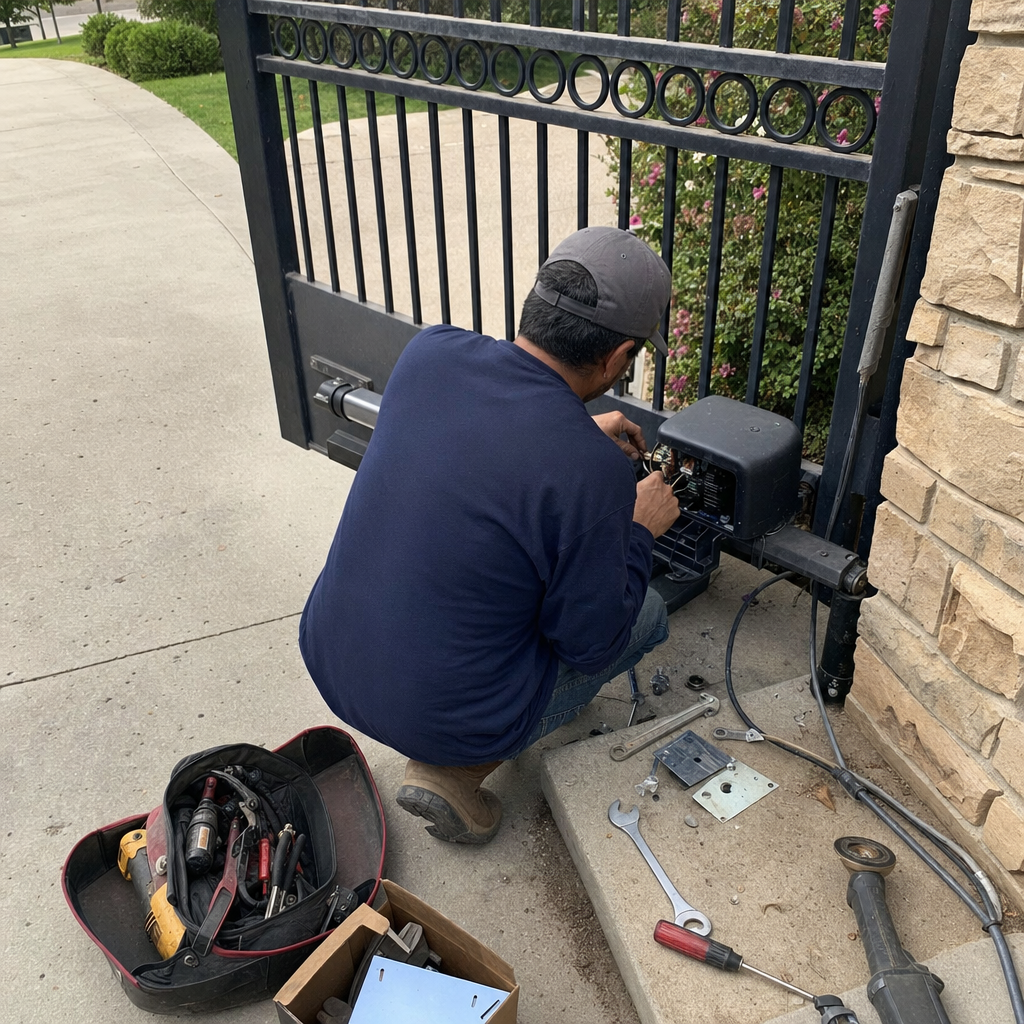
Last updated July 11, 2026
Gate Repair Permits, Codes & Inspections in KS: What You Need to Know
Here’s a scenario we see too often in Wichita: a homeowner in Riverside replaces a rotted swing gate post after the 2021 ice storm, thinks nothing of it, and five years later a title company flags unpermitted structural work during a sale. The repair was simple. The consequences weren’t. At Halcyon Automatic Gate Repair Kansas home, we’ve spent two decades working exclusively on gate systems across Sedgwick County, and we’ve learned that Kansas permit rules for gate work are counterintuitive. The jobs that look complex often don’t need permits; the ones that look simple sometimes do. This guide explains exactly where that line falls, what Wichita’s municipal code requires, and how to protect your property value when repairs become necessary.
Quick Answer
Most routine gate repairs in Kansas—hinge adjustments, operator troubleshooting, wheel replacement, and welding—do not require permits. However, structural post replacement, new electrical circuits to gate operators, and any modification to pool barrier gates trigger permit and inspection requirements under Wichita municipal code and the International Residential Code as adopted by Kansas. Unincorporated Sedgwick County follows different enforcement thresholds than the city of Wichita itself.
Table of Contents
- Which Gate Repairs Need Permits in Kansas?
- The Structural vs. Electrical Divide
- Pool Barrier Codes: When a Hinge Replacement Becomes Compliance Work
- Wichita Municipal Code vs. Sedgwick County Requirements
- How to Request a Permit Without Over-Triggering Inspections
- Why No Permit Talk Isn’t Always a Red Flag
- Common Mistakes to Avoid
- When to Call a Professional
- Frequently Asked Questions
- The Bottom Line
Which Gate Repairs Need Permits in Kansas?
Kansas operates under a modified version of the International Residential Code (IRC) and International Building Code (IBC), with local jurisdictions adding their own amendments. For gate work, the permit trigger isn’t about complexity—it’s about what the work touches.
Repairs that typically do NOT require permits:
- Operator diagnostics and replacement on existing electrical circuits
- Hinge, wheel, and roller replacement on existing gates
- Track realignment and debris clearing
- Welding cracks or breaks in existing gate frames
- Access control device replacement (keypads, remotes, intercoms) using existing low-voltage wiring
- Gate leaf replacement where posts and structure remain unchanged
Repairs that DO require permits:
- Post replacement or new post installation (structural element)
- New electrical circuits run from main panel to gate operator
- Gate modifications that alter pool barrier height, latch height, or self-closing function
- Any gate work that changes the property line fence configuration
- New automated gate installation on previously manual openings
In Wichita’s Delano neighborhood, we recently serviced a historic property where the owner had replaced both gate posts after freeze-thaw damage. The work was solid, but unpermitted. When they refinanced, the lender required a retroactive inspection that added six weeks to closing. The $150 permit would have prevented the headache entirely.
The key distinction: Kansas building officials view gate posts as fence posts, and fence posts as structural elements. Any structural element replacement requires a permit. This surprises homeowners because the gate itself—the moving part—often doesn’t.
The Structural vs. Electrical Divide
The two permit categories that matter most for gate repair are structural and electrical. Understanding the dividing line saves time and prevents failed inspections.
Structural permits cover anything bearing load or providing security enclosure. For gates, this means:
- Post replacement or augmentation: Even a single rotted wood post or bent steel post triggers this. Wichita’s building department treats this as fence construction, not gate maintenance.
- Footing work: If frost heave has shifted your gate post—and in Wichita’s clay-heavy soils after wet winters, this is common—any excavation and re-pouring requires a permit.
- Gate frame modifications that change dimensions: Widening a pedestrian gate or raising a driveway gate height changes the structural envelope.
Electrical permits cover power supply to operators:
- New 110V or 220V circuits: Running power from your house panel to a new or relocated operator always requires an electrical permit in Kansas.
- Existing circuit work: Replacing an operator on an existing dedicated circuit typically does not, provided no new conduit or wire is run.
- Low-voltage access control: Generally exempt, but Wichita requires permits for any device connecting to household power, including transformer-based systems.
We’ve worked on Viking and Elite systems in College Hill where the original installer ran power through an outdoor outlet—technically a code violation that complicates operator replacement. When we encounter this, we flag it for the homeowner rather than ignore it. Two decades of gate-only experience means we’ve seen your exact problem before, including the creative wiring that predates current code.
One critical detail: Kansas allows homeowners to pull their own electrical permits for work on their primary residence, but the work still requires inspection. For gate operators drawing 15+ amps, Wichita inspectors will verify GFCI protection, conduit burial depth (18 inches minimum for direct burial, 6 inches for rigid conduit), and disconnect location within sight of the operator.
Pool Barrier Codes: When a Hinge Replacement Becomes Compliance Work
This is where Kansas gate repair gets genuinely complicated—and where we see the most expensive mistakes.
Kansas adopted the 2021 International Swimming Pool and Spa Code (ISPSC) with amendments. Any gate serving as part of a pool barrier must meet specific operational standards:
- Self-closing and self-latching from any released position
- Latch mechanism at least 54 inches above ground, or on the pool side with release mechanism 54 inches high
- No gap greater than 4 inches under the gate
- Gate must swing away from the pool area
Here’s the trap: if your pool gate’s self-closing hinge fails and you replace it with a standard hinge, you’ve altered the barrier system. Wichita building officials classify this as barrier modification, not maintenance. The repair now requires a permit and compliance inspection.
We’ve serviced properties in Eastborough where a “simple” hinge replacement on a pool gate triggered a full barrier inspection that identified additional non-compliant fencing. The homeowner’s $200 repair became a $4,000 fence project.
The correct approach: use like-for-like replacement parts that maintain original compliance, or pull a barrier modification permit if you’re changing the mechanism type. We carry self-closing hinges for Ghost Controls and DoorKing systems specifically to avoid this scenario, and when a part isn’t available, we fabricate it—our in-house welding capability keeps your gate from becoming a replacement project.
Wichita’s climate compounds this issue. Our freeze-thaw cycles and summer humidity stress pool gate hardware more than in drier climates. Hinge springs corrode faster. Latch alignment drifts as posts heave. We inspect pool barrier function as standard practice, not an upsell, because the liability exposure is real.
Wichita Municipal Code vs. Sedgwick County Requirements
Wichita and unincorporated Sedgwick County operate under different enforcement frameworks, and the distinction matters for gate repair planning.
Wichita municipal code specifics:
- Building permits required for fence/gate posts over 6 feet tall or any automated gate system
- Electrical permits required for all new operator circuits; existing circuit replacement exempt
- Historic district properties (including parts of Riverside, Midtown, and Old Town) require Historic Preservation Office review for any visible gate changes
- Right-of-way permits required if gate swing encroaches on sidewalk or alley—common in dense neighborhoods like Delano and Douglas Design District
Unincorporated Sedgwick County:
- Building permits required for fences over 7 feet; gate posts generally follow fence rules
- Less stringent electrical enforcement for rural properties; agricultural exemptions may apply
- No historic district overlay
- Well and septic setbacks can affect gate placement in ways that don’t arise in city limits
We’ve worked on properties in Maize and Goddard where the owner assumed Wichita rules applied, only to learn the county’s different height thresholds meant their permit wasn’t required after all. Conversely, we’ve seen Derby and Haysville properties (separate municipalities with their own codes) where owners needed permits they hadn’t anticipated.
Douglas Ross takes the call and does the work—the owner is your technician. When we evaluate a repair in Wichita versus a surrounding community, we’re checking jurisdiction before we quote, not after we start.
How to Request a Permit Without Over-Triggering Inspections
A legitimate concern among homeowners: if I pull a permit for post replacement, will the inspector suddenly require my entire fence to meet current code? The answer is generally no, if you scope the permit correctly.
Step-by-step: requesting the right permit scope
- Identify the exact work: “Replacement of two 4×4 gate posts on existing driveway gate”—not “gate repair” or “fence work.”
- Specify no expansion: State explicitly that the work involves no new gate footprint, no height change, and no relocation.
- Attach photos: Current condition photos showing the existing gate and its context help inspectors understand this is maintenance, not improvement.
- Use the right permit type: In Wichita, gate post replacement falls under fence permits (building division), not electrical or mechanical.
- Schedule inspection promptly: Delays increase the chance of additional scrutiny or changed staff interpretation.
Where homeowners get into trouble: vague permit applications. “Fix gate” invites questions. “Replace rotted posts on existing 14-foot swing gate, no height or location change” does not.
We guide our Wichita customers through this when the repair requires permitting. It’s part of the job, not an extra service. Two decades in business specializing exclusively in gate systems means we’ve developed working relationships with local inspectors and understand their priorities.
One practical note: Wichita’s online permit system (Accela) allows detailed description fields. Use them. The 15 minutes spent on precise language saves weeks of back-and-forth.
Why No Permit Talk Isn’t Always a Red Flag
This section might seem counterintuitive from a company that advocates for code compliance. But after 20 years in Wichita’s gate repair market, we’ve learned to distinguish informed judgment from willful ignorance.
Legitimate reasons a specialist might not mention permits:
- The repair genuinely falls below permit thresholds (operator swap on existing circuit, hinge replacement on non-pool gate, track cleaning)
- The jurisdiction doesn’t require permits for the specific work (rural Sedgwick County, certain maintenance categories)
- The contractor carries general liability and workers’ compensation insurance that covers the work regardless of permit status—not ideal, but not fraudulent
Actual red flags:
- Contractor is “unaware” that post replacement requires permits—this indicates unfamiliarity with basic Kansas building code
- Pressure to pay cash to “avoid the permit hassle”—this is evasion, not efficiency
- No written contract or invoice—permits create paper trails some operators deliberately avoid
- Refusal to pull permits even when homeowner requests it—suggests the contractor isn’t licensed to do so
We service 9 major brands, so your system is never out of scope. But we also know our scope ends where unpermitted structural work begins. When a Wichita customer calls about post replacement, we discuss permits upfront. When they call about a Gate Motor & Opener in Kansas City or Wichita area that’s simply stopped responding, we don’t invent permit requirements that don’t exist.
413 customers and a 4.9-star average don’t happen by accident—they happen one honest job at a time. Part of that honesty is knowing when permits matter and when they don’t.
Common Mistakes to Avoid
- Assuming “repair” means “no permit needed”: In Wichita, post replacement is repair work to you, but structural work to the building department. Verify before starting.
- Using non-self-closing hardware on pool gates: Even a temporary fix with standard hinges violates ISPSC barrier requirements and creates liability if a child accesses the pool.
- Ignoring right-of-way rules: Gates that swing over sidewalks or alleys need encroachment permits separate from building permits—Wichita enforces this more strictly since the 2019 pedestrian safety ordinance.
- DIY electrical to operators: Kansas homeowners can pull electrical permits, but gate operators require proper grounding, GFCI protection, and disconnect placement. Failed inspection means rework costs that exceed professional installation.
- Not checking historic district overlays: Properties in Wichita’s designated historic districts need HPO approval for visible gate changes, even for permitted work. This runs parallel to, not in place of, building permits.
- Assuming county rules match city rules: Moving from Wichita to unincorporated Sedgwick County changes enforcement thresholds. Don’t apply city experience to rural properties without verification.
- Letting permits lapse: Wichita permits expire 180 days after issuance if no inspection is requested. Partial work followed by delay can require re-permitting.
When to Call a Professional
Call a gate specialist when your repair touches structure, power, or pool barriers—or when you’re uncertain which category applies. At Halcyon Automatic Gate Repair Kansas, we evaluate permit requirements as part of every quote. Douglas Ross personally assesses whether your specific repair in Wichita needs building department involvement, and we handle the paperwork when it does.
We’re not a general handyman service that “also does gates.” We’re not a fencing company with a gate add-on. Two decades of gate-only experience means we’ve navigated Wichita’s permit landscape hundreds of times, from historic district approvals to county agricultural exemptions. Gate Repair in Kansas City and Wichita customers alike get the same owner-led assessment: what’s actually required, what’s actually wrong, and what it actually takes to fix it permanently.
Halcyon Automatic Gate Repair Kansas offers free estimates in Wichita—call (833) 754-6310.
Frequently Asked Questions
No, if you’re replacing the operator on an existing dedicated electrical circuit. Yes, if the replacement requires running new power from your main panel or changing the circuit capacity. Most operator swaps on existing 110V or 220V circuits are maintenance, not new electrical work. Call (833) 754-6310 for an exact quote—estimates are free.
Wichita’s building permit fees for fence and gate work start around $50–$150 for residential post replacement, with electrical permits for new operator circuits running $75–$200 depending on amperage. Sedgwick County fees are comparable but may vary for rural properties. These costs are minor compared to the title complications unpermitted work can cause during sale or refinance.
You can perform maintenance like lubrication and minor adjustment without permits. However, any hardware replacement that affects self-closing or self-latching function technically requires a barrier modification permit under Wichita’s adoption of the ISPSC. Many homeowners skip this, but if an incident occurs, insurance coverage may be contested. We recommend documenting like-for-like parts replacement even when permits aren’t pulled.
Enforcement is typically reactive, not proactive. The most common trigger is property sale, refinance, or insurance claim. Wichita building officials can require removal, reconstruction, or retroactive permitting with penalties. We’ve seen unpermitted post replacement delay closings by 4–8 weeks while retroactive inspections and corrections are completed.
Either approach works in Kansas. Homeowners can pull their own permits for work on their primary residence. Licensed contractors can pull permits on behalf of owners. If your contractor refuses to pull permits or suggests you “handle it later,” this is a warning sign. At Halcyon, we pull permits when required and guide you through the process when you prefer to handle it yourself.
Simple fence/gate permits in Wichita typically process in 3–5 business days through the Accela system. Electrical permits may take 5–7 days if load calculations require review. Historic district properties add 10–14 days for HPO review. We factor these timelines into project scheduling so your gate isn’t stuck open longer than necessary.
The Bottom Line
Gate repair permits in Kansas follow a simple principle that’s hard to apply: maintenance is free, structure and power are permitted. The specific repairs most homeowners consider routine—post replacement, electrical upgrades, pool barrier hardware—are exactly the ones that trigger oversight. Wichita’s municipal code adds layers for historic districts and right-of-way encroachment that don’t exist in unincorporated Sedgwick County. Understanding these distinctions before work begins protects your property value, your insurance coverage, and your timeline. When in doubt, verify with the building department or work with a specialist who navigates these questions as part of standard practice.
Written by Douglas Ross, Owner & Lead Technician at Halcyon Automatic Gate Repair Kansas, serving Wichita since 2006.