
Last updated July 11, 2026
How to Hire a Gate Repair Contractor in Wichita: A Step-by-Step Guide
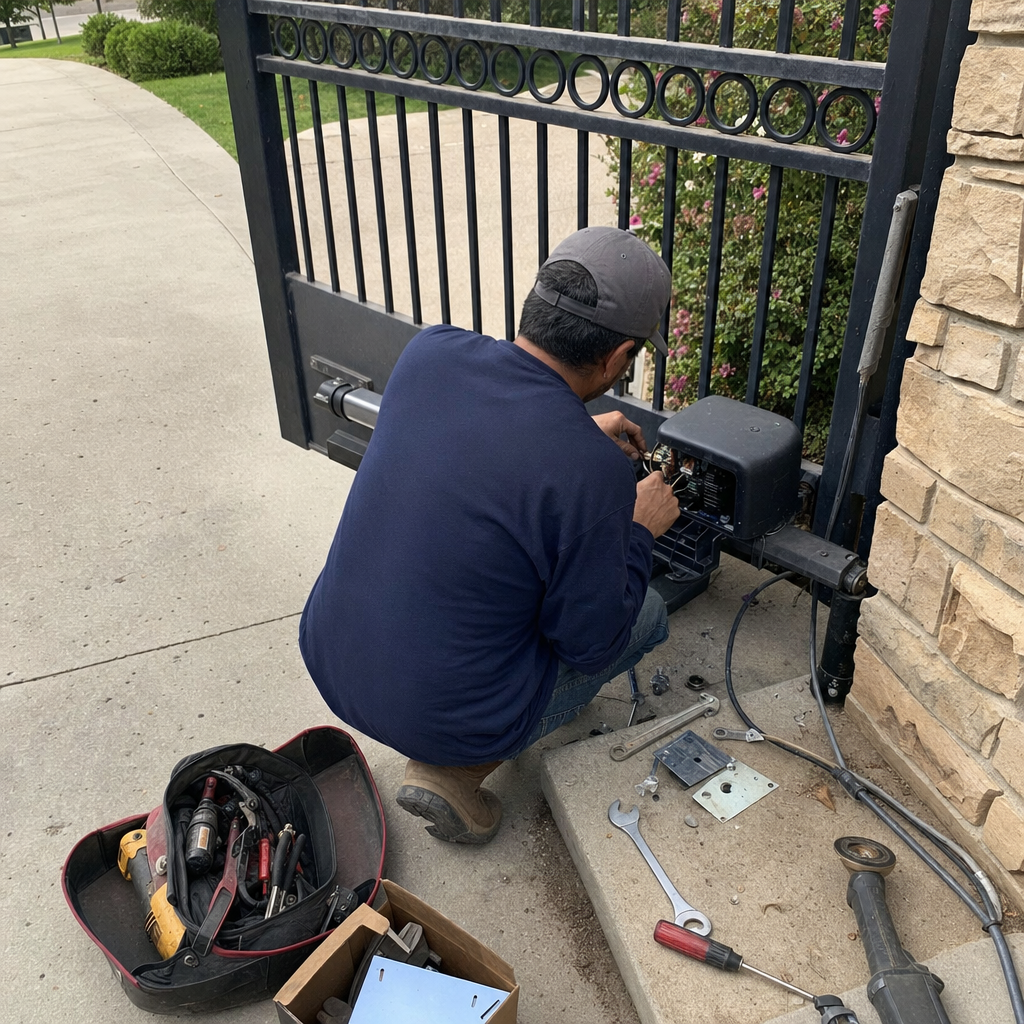
Ask any gate repair contractor in Wichita whether they can fabricate a replacement bracket in-house if one isn’t available through a supplier. The answer tells you more about their actual capability than any review on Google. Most companies that rank for “gate repair” in the Wichita market are fencing contractors or general handymen who added the service to their website—not specialists who’ve spent years diagnosing the 47 ways a gate motor can fail. In this guide, you’ll learn the exact questions that separate a true gate specialist from a generalist with a gate opener on the truck, how to read a quote line by line, and why the person who answers your phone should be the same person who shows up with tools in hand.
Quick Answer
Hiring a gate repair contractor in Wichita starts with verifying they specialize exclusively in gate systems—not fencing or general handyman work. Ask whether they fabricate parts in-house, which brands they’re factory-trained on, and whether the owner or a rotating crew will handle your repair. Request an itemized quote, confirm they carry general liability and workers’ compensation coverage, and check that their reviews mention specific gate brands and technical problems rather than generic praise.
Table of Contents
- Why “Gate Repair” on a Website Doesn’t Mean Gate Repair in Real Life
- The Six Questions That Expose a Generalist
- How to Read a Gate Repair Quote Line by Line
- Why the Owner-on-the-Job Model Matters in Wichita
- Kansas Licensing, Insurance, and What Actually Protects You
- Brand Knowledge and Parts Availability: The Real Test
- Red Flags Specific to the Wichita Market
- Your Final Decision Checklist
Why “Gate Repair” on a Website Doesn’t Mean Gate Repair in Real Life
The Wichita market has a particular problem: we’re a mid-sized city with enough demand for gate services to attract generalists, but not so much that pure specialists are obvious in search results. When your automatic gate fails in Riverside or College Hill, you’ll find fencing companies, landscaping contractors, and handyman services all advertising gate repair. The distinction matters because gates are electromechanical systems with safety circuits, force settings, and interlocking components—not carpentry with electricity added.
Here’s what we’ve observed after two decades in Wichita: a fencing company builds gates. They understand hinges, latches, and post alignment. When an automatic opener fails, they’re often guessing. We’ve been called to jobs in Delano where a fencing contractor replaced a “bad” motor that was actually fine—the problem was a failed limit switch in the control board, a $45 part that takes 20 minutes to diagnose if you know what you’re looking at. The homeowner paid for a $1,200 motor they didn’t need.
A true gate specialist lives in the overlap of welding, electrical troubleshooting, hydraulic systems (for commercial operators), and control logic. They don’t “also do” gates. They only do gates. In Wichita’s climate—where summer humidity swells wooden gate frames and winter temperature swings contract metal components—that specialized experience translates directly to faster, accurate diagnosis.
One practical test: ask how many gate-specific service calls they completed last month. A specialist should answer without hesitation. A generalist will deflect to “we do a lot of outdoor projects” or give a combined number that includes fence repairs and deck builds.
The Six Questions That Expose a Generalist
These questions work because they target the gap between marketing language and actual capability. We’ve heard enough stories from Wichita homeowners to know which answers signal trouble.
1. “Can you fabricate a replacement part if it’s discontinued?”
The honest answer from most contractors is no. They order from catalogs. When Linear or Viking discontinues a bracket pattern, or when a custom gate in Crown Heights uses hardware from a defunct local fabricator, they’re stuck. A specialist with in-house welding and machining capability—like our shop—can measure, cut, and weld a replacement. This single capability separates technicians from parts-swappers.
2. “Which gate brands are you factory-trained or certified to service?”
Generalists typically service one or two brands they happened to install. A specialist should fluently discuss Ghost Controls residential systems and DoorKing commercial operators in the same conversation. If they pause, hedge, or say “we can figure it out,” you’re paying for their learning curve.
3. “Will the person who diagnoses my gate also complete the repair?”
Crew-dispatch operations common in larger markets send one person to estimate, another to order parts, and a third to install. In Wichita, where we’re small enough that reputation travels, this handoff model creates miscommunication. The estimator sees a “slow gate.” The installer arrives without knowing the specific brand’s force-limitation protocol. The gate still doesn’t work right. Douglas Ross takes the call and does the work—the owner is your technician.
4. “What’s your typical response time for a gate that won’t open at all?”
A gate that won’t open traps vehicles, blocks emergency access, and compromises security. A specialist keeps common failure parts in stock and prioritizes these calls. Vague answers about “checking schedules” or “maybe tomorrow” suggest they don’t stock parts and are ordering after diagnosis.
5. “Can you show me an itemized quote with parts, labor, and trip charge separated?”
Lump-sum quoting hides markup and prevents comparison. We’ll cover this in detail in the next section.
6. “What percentage of your business is gate-specific versus fencing or other services?”
Anything under 70% should concern you. At Halcyon, it’s 100%. That concentration means we’ve encountered your exact failure mode before—probably multiple times in Wichita’s specific climate and soil conditions.
How to Read a Gate Repair Quote Line by Line
Gate repair quotes in Wichita range from illegible scribbles to multi-page proposals. Here’s what should appear, what shouldn’t, and what vague language signals.
Required Line Items
- Trip charge or service call fee: Standard in Wichita is $75–$150, often credited toward repair if you proceed. Beware “free estimates” that mysteriously appear as hidden fees later.
- Diagnostic labor: Separated from repair labor. A proper diagnosis on a multi-component system (safety loops, photocells, control board, motor) takes 30–90 minutes and should be itemized.
- Parts with manufacturer and part number: “Control board” is insufficient. “LiftMaster K1A6838 Logic Board” is specific and verifiable.
- Repair labor hours and rate: Should align with the actual work. Welding and fabrication take longer than plug-in replacement; both should be transparently priced.
- Warranty terms by component: Parts, labor, and trip charges may carry different warranty periods. Get it in writing.
Red Flag Language
- “Miscellaneous materials” or “shop supplies”: Legitimate contractors use specific line items. This catch-all hides markup.
- “Replace motor as needed”: “As needed” after diagnosis means they haven’t diagnosed yet. The quote should state what they’ve found.
- No separation of parts and labor: Prevents you from verifying parts pricing and obscures true labor rates.
- “Complete system rebuild” without component detail: Often code for replacing everything because they can’t identify the actual failure.
In our experience across Wichita neighborhoods from Bel Aire to Oaklawn-Sunview, the most expensive repair is the one that doesn’t fix the problem. An itemized quote from a specialist who diagnosed correctly the first time often costs less than a cheap quote followed by return visits.
Why the Owner-on-the-Job Model Matters in Wichita
Wichita’s gate repair market includes national franchises, regional fencing companies with gate divisions, and solo operators. The owner-on-the-job model—where Douglas Ross personally handles service calls—creates accountability chains that disappear in larger organizations.
Consider what happens when a crew-sent technician misdiagnoses your gate in Eastborough. They report “motor failure” to dispatch. The office orders a motor. The motor arrives. A different technician installs it. The gate still malfunctions because the actual problem was a pinched low-voltage wire in the conduit—something the first technician didn’t trace because they weren’t briefed on the system’s history and didn’t have time allocated for methodical diagnosis.
With owner-led service, the person who hears your description over the phone is the same person who remembers that Halcyon replaced a similar Ghost Controls operator in your neighborhood three years ago, recognizes the symptom pattern, and arrives with the right test equipment and likely parts. There’s no information loss in handoffs because there are no handoffs.
This matters particularly for intermittent failures—the gate that works fine in cool morning temperatures but stalls by afternoon, or the operator that reverses randomly. These require observational skill and patience that crew-dispatch models rarely incentivize. When the owner’s reputation is directly on every job, the incentive aligns with thoroughness.
Two decades of gate-only experience means we’ve seen your exact problem before. That accumulated pattern recognition—across Wichita’s freeze-thaw cycles, our clay-heavy soils that shift gate posts, our occasional severe storms that damage track systems—is what owner-led service preserves and passes directly to the customer.
Kansas Licensing, Insurance, and What Actually Protects You
Kansas does not require a specific “gate contractor” license at the state level. This regulatory gap is why so many generalists can advertise gate repair without meaningful qualification. Here’s what actually protects you and what to verify.
General Liability Insurance
Covers property damage and bodily injury caused by the contractor’s work. A gate falling during repair, electrical damage to your home’s panel, or injury to a bystander—these scenarios fall under general liability. Request a certificate of insurance naming you as additional insured for the project duration. Minimum coverage of $1 million is standard for contractors handling heavy automated equipment.
Workers’ Compensation Insurance
Required in Kansas for businesses with employees. Critical for your protection: if an uninsured worker is injured on your property, your homeowner’s policy may be tapped. Solo owner-operators may legally exempt themselves, but any helper, apprentice, or subcontractor must be covered. Ask directly: “Is everyone who will be on my property covered by workers’ comp?”
Electrical and Low-Voltage Work
Gate operators connect to your electrical system and involve low-voltage control circuits. Kansas requires licensed electricians for certain electrical work, though gate-specific low-voltage wiring often falls into regulatory gray areas. A specialist should be able to articulate exactly what work they’ll perform and whether it requires an electrical permit or licensed electrician collaboration. Vague answers suggest they don’t know the boundary themselves.
What We Recommend Requesting
- Certificate of insurance with current dates and your address listed
- Written confirmation that all on-site personnel carry workers’ compensation coverage
- Clarification on whether any electrical permit is required for your specific repair
- Warranty terms in writing, including whether warranty work requires their return or if they’ll reimburse another contractor if they fail to honor it
We’ve repaired gates in Wichita where previous contractors disappeared after payment, leaving homeowners with no recourse for failed repairs. Verifying these protections before work begins takes ten minutes and prevents months of frustration.
Brand Knowledge and Parts Availability: The Real Test
Automatic gate systems are not interchangeable. A contractor who “works on all brands” typically means they’ll attempt any brand and learn on your equipment. True fluency across multiple manufacturers requires years of accumulated service manuals, diagnostic sequences, and parts relationships.
We service 9 major brands, so your system is never out of scope. This isn’t marketing language—it means we stock common failure parts for LiftMaster, FAAC, BFT, Linear, Viking, Ghost Controls, DoorKing, Elite, and Mighty Mule. When a Wichita homeowner calls about a Viking operator that stopped mid-cycle, we know Viking’s specific fault code sequence without looking it up. When a commercial property manager in Old Town has a DoorKing system with intermittent access card failures, we’ve diagnosed that exact symptom on that exact board revision.
Here’s where parts availability becomes critical. Many gate operators use proprietary control boards, gear assemblies, and safety devices. When a manufacturer discontinues a part—or when supply chain delays stretch to months—a generalist’s only option is replacing the entire operator. When a part isn’t available, we fabricate it—our in-house welding capability keeps your gate from becoming a replacement project.
We’ve machined replacement brackets for custom ornamental gates in College Hill that were installed by a fabricator who retired a decade ago. We’ve welded new hinge pins for heavy industrial gates in the north industrial corridor where off-the-shelf hardware would fail in six months. This capability doesn’t appear on every contractor’s website because most contractors don’t have it. Ask the question directly: “If my part is discontinued, what happens?” The answer reveals everything.
Red Flags Specific to the Wichita Market
Our local market has characteristics that create specific warning signs. After 20 years serving Wichita, these patterns repeat.
- “We need to replace the entire operator” on a system under 10 years old: Quality operators from FAAC, BFT, or DoorKing have 15–20 year lifespans with proper maintenance. Total replacement proposals on younger systems often indicate inability to diagnose component-level failures.
- No physical address or only a PO box: Wichita is small enough that legitimate contractors have verifiable shop locations. Mobile-only operations with no fixed address may be here today, gone tomorrow.
- Pressure to decide immediately: “This price is only good today” or “I have another guy who wants this motor” are high-pressure tactics. Gate repairs are rarely true emergencies requiring instant commitment.
- Inability to explain the failure mechanism: A competent technician can explain what failed, why it failed, and how the repair addresses it in terms you understand. “It’s just worn out” without specifics suggests they haven’t diagnosed.
- No reviews mentioning specific brands or technical details: Generic five-star reviews (“Great service, nice guy”) are easy to generate. Reviews that mention “replaced my Linear actuator” or “fixed the Ghost Controls limit switch” indicate real technical work performed.
- Quotes significantly below market without explanation: Wichita’s market rates for qualified gate repair are relatively consistent. A quote 40% below others often means uninsured operation, planned upselling, or corner-cutting on parts quality.
Your Final Decision Checklist
Use this structured evaluation before signing any agreement. Score each contractor; the pattern becomes clear.
| Criteria | What to Verify | Why It Matters |
|---|---|---|
| Specialization | Gate work represents 70%+ of their business | Concentrated experience reduces misdiagnosis |
| Brand fluency | Can discuss your specific brand’s common failures | Avoids learning curve on your equipment |
| In-house fabrication | Welding and machining capability for custom/discontinued parts | Prevents unnecessary full replacement |
| Owner involvement | Owner serves as lead technician, not just manager | Accountability and accumulated expertise |
| Quote transparency | Itemized parts, labor, trip charge with part numbers | Prevents hidden costs and enables comparison |
| Insurance verification | Certificate provided; workers’ comp confirmed | Protects you from liability |
| Warranty specificity | Written terms by component (parts vs. labor) | Defines recourse if repair fails |
| Local reputation depth | Reviews mention specific technical details and brands | Confirms actual gate work, not generic service |
413 customers and a 4.9-star average don’t happen by accident—they happen one honest job at a time. That consistency across hundreds of real service calls is what you’re evaluating for in any contractor.
Common Mistakes to Avoid
- Hiring based on lowest quote alone: In Wichita’s Riverside neighborhood, we’ve corrected repairs where a low bidder used a generic control board incompatible with the safety loop system, creating a liability hazard. The “savings” cost 40% more to fix.
- Assuming fencing expertise equals gate expertise: Beautiful fence work requires different skills than diagnosing why a gate installation from five years ago now reverses randomly. The contractor who built your fence may be unqualified to repair its automation.
- Neglecting to verify insurance: After the 2019 tornadoes in northeast Wichita, we encountered multiple uninsured contractors performing emergency gate repairs. Homeowners who didn’t verify coverage assumed risk they didn’t realize.
- Accepting verbal warranties: “Don’t worry, we’ll take care of you” evaporates when the technician changes companies. Get warranty terms in writing with specific durations and coverage scope.
- Ignoring climate-specific factors: Wichita’s clay soils shift with moisture, affecting gate post alignment. A contractor who doesn’t mention soil conditions or drainage around your gate posts may not understand why your gate binds seasonally.
- Waiting until complete failure: Grinding operators, slow response times, and intermittent safety sensor failures are early warnings. Emergency calls limit your contractor choice and often cost more. Address symptoms when they appear.
When to Call a Professional
Call a gate repair specialist immediately if your gate reverses unexpectedly, makes grinding or straining sounds, stops responding to remote or keypad commands, or shows visible damage to hinges, track, or operator mounting. These symptoms indicate safety system failures or mechanical problems that worsen with continued operation. For commercial properties in Wichita, any gate failure that blocks emergency vehicle access requires same-day response.
Halcyon Automatic Gate Repair Kansas offers free estimates in Wichita—call (833) 754-6310. Douglas Ross will assess your system, explain the failure mechanism, and provide an itemized quote with no pressure to commit. We’ve served this market since 2006, and we’ve learned that the best customer is an informed one who chose us because we demonstrated real capability, not because we talked fastest.
Frequently Asked Questions
Most residential gate repairs in Wichita range from $180 for minor adjustments to $850 for control board replacement, with commercial systems running higher depending on operator size and access control complexity. Emergency or after-hours service typically adds $100–$200. Call (833) 754-6310 for an exact quote—estimates are free.
Repair is almost always more economical if your operator is under 12 years old and from a major brand like Linear, Viking, or DoorKing. Replacement becomes justified when multiple major components fail simultaneously, parts are discontinued without fabrication options, or efficiency upgrades (solar compatibility, smartphone integration) justify the investment. We evaluate this honestly—when a part isn’t available, we fabricate it rather than defaulting to replacement.
For common failures on major brands, same-day repair is often possible because we stock typical failure parts. Complex diagnostics, custom fabrication, or discontinued parts may extend to 24–48 hours. We prioritize gates that are completely inoperable or blocking emergency access. Call (833) 754-6310 to discuss your situation—we’ll give you an honest timeline.
Request a certificate of insurance directly from their insurance provider, not a photocopy from the contractor. Verify general liability and workers’ compensation coverage with current dates. In Kansas, you can also check business registration status through the Kansas Secretary of State’s office. Never assume—uninsured gate work creates liability exposure you may not discover until a claim arises.
This pattern typically indicates thermal expansion affecting electronic components, voltage drop under heat load, or safety sensor misalignment that worsens as materials expand. Wichita’s summer temperature swings—often 25°F between morning and peak afternoon—exaggerate these failures. It’s a diagnostic signature we recognize immediately and address by identifying the heat-sensitive component rather than replacing random parts.
We serve the full Wichita metropolitan area including Bel Aire, Park City, Maize, Haysville, and Derby. Our service radius covers all Sedgwick County and extends into surrounding counties for commercial clients. Travel charges apply beyond 25 miles from central Wichita but are disclosed upfront in your quote.
The Bottom Line
Hiring a gate repair contractor in Wichita requires looking past search rankings to verify actual specialization. The right contractor demonstrates brand-specific fluency, offers in-house fabrication capability, provides transparent itemized quotes, and carries verified insurance. Most importantly, they can explain your specific failure in terms you understand and stand behind their work with specific warranty terms. The owner-on-the-job model eliminates the information loss and accountability gaps common in crew-dispatch operations. Take time to ask the hard questions—your gate’s reliability and your family’s security depend on getting this choice right.
Written by Douglas Ross, Owner & Lead Technician at Halcyon Automatic Gate Repair Kansas, serving Wichita since 2006.