Why Is My Gate Motor Not Working in Kansas, KS? Most “Motor” Failures Are Actually One of Three Different Parts
A gate motor that won’t run usually isn’t the motor itself—it’s most often a failed run capacitor ($25–$50 part), a damaged control board from a power surge, or actual motor winding failure. Knowing which one you’re dealing with changes the repair cost from under a hundred dollars to several hundred, and most Kansas homeowners can spot the difference with a few observation points we’ll cover below. If your gate is stuck open or closed right now, call Halcyon Automatic Gate Repair Kansas at (833) 754-6310—Douglas Ross answers the call and handles the diagnosis personally.

Here’s the thing we run into almost daily: someone tells us “the motor died,” and what they mean is the gate won’t move. But “won’t move” is a symptom, not a diagnosis. In twenty years of working exclusively on gate systems across Kansas City, Kansas—from the historic homes in Westheight Manor where Douglas Ross grew up, to newer subdivisions in Piper and Edwardsville—we’ve learned that how the gate fails tells us exactly which component failed. That’s the difference between a $75 repair and a $600 replacement.
The Three Parts Homeowners Call “The Motor”
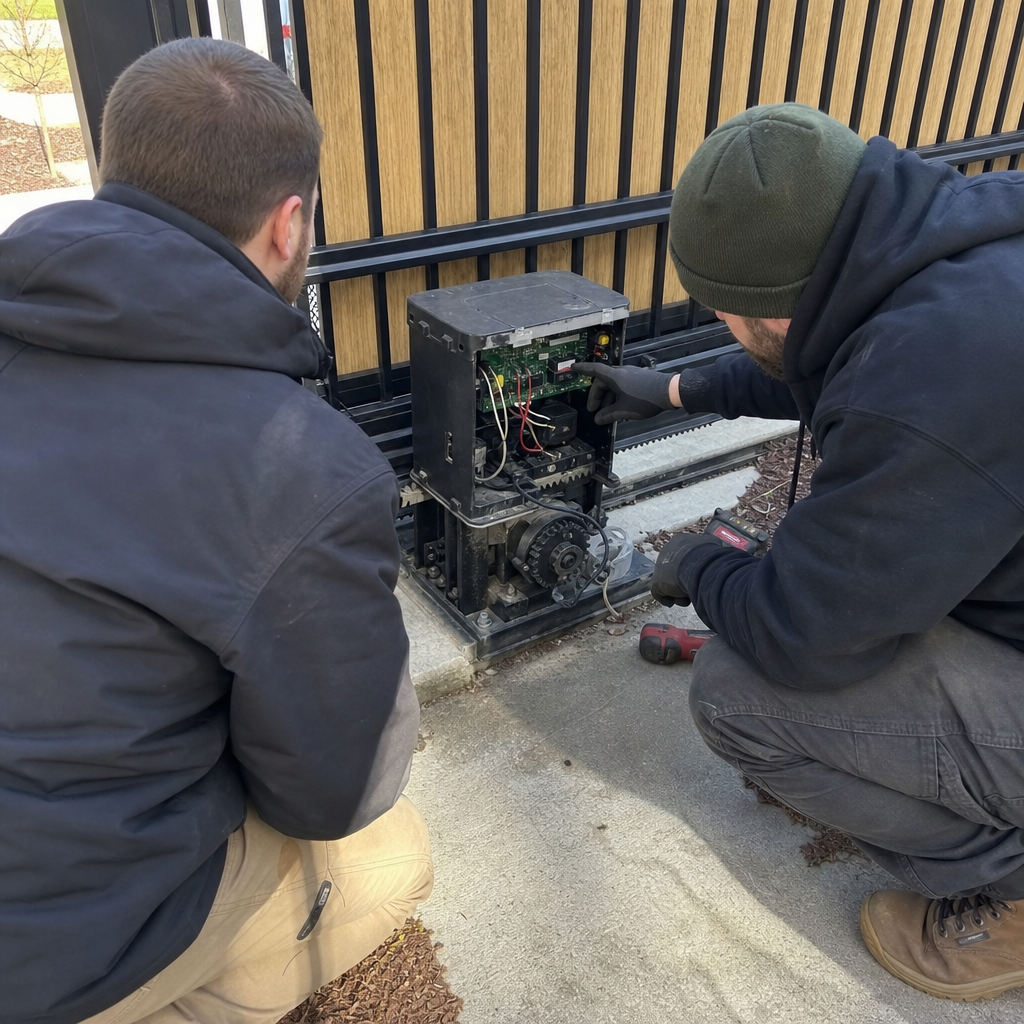
When we say Gate Motor & Opener, we’re talking about a system with distinct components. Most homeowners, understandably, see the whole box as “the motor.” But three separate parts can stop your gate, and each has its own repair path:
- The motor winding — The actual electric motor that turns the gear. When this fails, the gate does nothing. No hum, no click, no movement. Often smells like burned electrical insulation.
- The run capacitor — A cylindrical component that gives the motor the initial jolt to start turning. When this fails, the motor hums loudly but the gate doesn’t move. The motor may feel warm or hot to touch after a few minutes.
- The control board — The “brain” that receives signals from remotes, keypads, and safety sensors, then tells the motor when to run, which direction, and for how long. When this fails, symptoms vary widely: gate runs continuously, reverses randomly, or does nothing at all despite normal power.
Douglas Ross puts it this way: “Tell me what it’s doing — and what it was doing right before that. That’s usually where the answer is.” That sequence matters because capacitor failure and control board failure often follow different events. A capacitor degrades gradually; a control board dies suddenly, usually after a specific incident.
Capacitor Failure: The Most Misdiagnosed “Motor” Problem
If your gate hums but won’t budge, you almost certainly have a failed run capacitor. This is the single most underdiagnosed issue in residential automatic gate systems, and it’s a shame because it’s also the cheapest fix.
The capacitor stores a charge and releases it to give the motor starting torque. Without that jolt, the motor can’t overcome the initial resistance of the gate’s weight and friction. It sits there, drawing current, humming, getting warmer. Left long enough, this condition can damage the actual motor windings—turning a $40 capacitor replacement into a full motor replacement.
Here’s what we look for on a capacitor call:
- Audible hum from the operator housing when the remote or keypad is activated
- Gate attempts to move slightly, then stops, or doesn’t move at all
- Motor housing warm or hot after several activation attempts
- Problem developed gradually over weeks—gate slower to start, then stopped starting entirely
The capacitor itself is a simple cylinder, usually 2–3 inches long, with two terminals. We carry replacements for common ratings on every truck, and the swap takes about twenty minutes once we’ve confirmed the diagnosis. On a Mighty Mule or Elite residential system, you’re looking at roughly $75–$150 total for diagnosis and replacement. On commercial-grade operators like FAAC or LiftMaster, the capacitor may be larger and harder to access, but the principle is identical.
Why Kansas Summers Destroy Capacitors Faster
This is where local knowledge pays off. In Kansas, we see a predictable spike in capacitor failures every August—not coincidentally, after two months of 90-plus degree days. Capacitors are electrolytic components, and heat accelerates the chemical breakdown of their internal dielectric. An operator housing sitting in direct sun on a west-facing driveway in Kansas can easily reach 140°F internally, even when the ambient temperature is “only” 95°F.
We’ve replaced capacitors in Piper homes where the operator had no shade coverage whatsoever, and in Edwardsville commercial installs where the equipment pad was asphalt-surrounded and heat-radiating. The fix isn’t just replacing the capacitor—it’s also noting whether the installation location needs ventilation improvement or a sun shield to prevent repeat failure. That’s the kind of observation you get from someone who’s spent two decades watching the same seasonal pattern in the same climate.
Control Board Failure: The Power Surge Pattern
When a motor “dies” immediately after a thunderstorm, a grid outage, or any electrical event, we almost always find control board damage—not motor damage. The board takes the voltage spike; the motor is usually fine. This is one of the most expensive misdiagnoses in our industry because a generalist contractor who doesn’t understand gate electronics will quote you a complete operator replacement when you need a board swap.
Douglas Ross has tracked this pattern across hundreds of Kansas service calls over twenty years. The board contains sensitive microelectronics—relays, capacitors, traces—that sacrifice themselves to protect downstream components. A motor winding is comparatively robust. So when someone tells us “the motor burned up after the storm,” our first question is: “Did you see any lights flicker in the house? Any other electronics affected?” If yes, we’re pulling the control board cover before we condemn the motor.
Control board symptoms differ from capacitor symptoms:
- Sudden onset after a known electrical event (storm, outage, utility work)
- Gate behaves erratically—moves partway, reverses without obstruction, ignores remotes
- LED diagnostic lights on the board show fault codes or are completely dark
- No humming from the motor at all—board isn’t even attempting to start the sequence
Board replacement costs vary significantly by brand and age. A current-model LiftMaster or FAAC board might run $200–$400 for the part plus labor. For older or discontinued operators, we first check whether we can source the board—Halcyon carries extensive inventory and supplier relationships for this reason. When a board is truly unavailable, that’s when our in-house fabrication capability becomes relevant: we can sometimes retrofit a compatible control solution rather than forcing a complete operator replacement.
Actual Motor Failure: When the Windings Give Out
True motor failure is less common than the other two, but it happens. The motor windings—copper wire coils that create magnetic fields—can overheat and short, or the bearings can seize after years of operation.
Motor failure signs are distinct:
- Complete silence when activated—no hum, no click, no LED response at the motor
- Burned electrical smell from the operator housing
- Visible damage to motor housing (cracks, corrosion, water intrusion)
- Gate requires manual override with excessive force—mechanical seizure
On a residential swing gate operator, motor replacement typically runs $300–$600 depending on brand and accessibility. On commercial slide gate systems with larger operators, motor replacement can exceed $800. This is where brand fluency matters: a Viking or DoorKing motor has different mounting, wiring, and control interfaces than a BFT or Ghost Controls unit. We’ve seen generalist contractors order “compatible” motors that required extensive modification to fit, or worse, wire incorrectly and damage the new motor immediately.
Halcyon’s approach is to confirm motor failure definitively before quoting replacement. We test the windings for continuity and resistance, check for ground faults, and verify that the control board and capacitor are delivering proper voltage under load. Only then do we recommend motor replacement. That’s how you avoid paying for a motor you didn’t need.
Brand-Specific Diagnosis: Why Generalists Struggle
Here’s something the typical handyman or fencing contractor won’t tell you: diagnosing a gate motor requires brand-specific knowledge and often brand-specific tools. The nine major brands we service—LiftMaster, FAAC, BFT, Linear, Viking, Ghost Controls, DoorKing, Elite, and Mighty Mule—each use different diagnostic approaches.
FAAC operators require a proprietary programming unit to read detailed fault codes. BFT systems use a specific handheld interface for parameter adjustment and error history. Ghost Controls, popular in Kansas residential installations for its solar-compatible options, has a different LED blink pattern system than Elite or Mighty Mule. A contractor who “does gates sometimes” may carry a multimeter and a willingness to guess. Douglas Ross carries the diagnostic interfaces, has the factory training, and has seen the failure patterns enough to recognize them before the tool comes out.
This matters because misdiagnosis costs you twice: once for the wrong repair, again for the right one. We’ve been called to jobs in Kansas where a gate was “fixed” three times by three different companies before we identified a simple control board fault that the others lacked the equipment to detect.
What You Can Safely Check—and When to Stop
We don’t recommend DIY electrical work on gate systems. These are 110V or 220V devices with live terminals, and some components hold lethal charge even when unplugged. That said, there are safe observations you can make that help us help you faster:
- Check whether the operator’s power indicator LED is on—this tells us if the board is receiving power
- Note whether the gate makes any sound when activated—hum, click, or nothing
- Check for visible damage to the housing, wiring, or antenna
- Verify that the manual release functions and the gate moves freely by hand
Do not open the operator housing, do not touch terminals, and do not attempt capacitor testing—capacitors can retain lethal charge and cause serious injury or death even when disconnected. If your observations point to any of the failures described above, call a trained professional. The diagnostic fee is far less than an emergency room visit or a funeral.
Typical Repair Costs in the Kansas Market
| Component | Symptom | Typical Repair Cost |
|---|---|---|
| Run capacitor | Hums, won’t move | $75–$150 |
| Control board | Erratic or no response after electrical event | $250–$550 |
| Motor replacement | No sound, burned smell, mechanical seizure | $300–$800+ |
| Full operator replacement | Multiple failures, obsolete system | $1,200–$3,500 |
These are Kansas market ranges based on our 2024–2025 service calls. Exact pricing depends on brand, accessibility, and whether the operator is in a standard or custom configuration. We provide upfront estimates before any work begins.
FAQs
Most gate motor repairs in Kansas run $75–$550, with capacitor replacements at the low end and control board replacements toward the middle. True motor replacement or full operator replacement costs more, but we confirm the actual failure before quoting anything. Call (833) 754-6310 for a free, no-pressure estimate—Douglas Ross handles every assessment personally.
This is almost always a failed run capacitor, not the motor itself. The capacitor provides the starting jolt the motor needs to overcome initial resistance; without it, the motor draws power and hums but can’t turn. It’s a $25–$50 part and a common fix, but don’t run it repeatedly—prolonged humming can overheat and damage the motor windings. Call us before that happens.
A power surge typically damages the control board, not the motor. The board’s sensitive electronics absorb the voltage spike to protect downstream components, including the motor. We’ve replaced dozens of boards after Kansas thunderstorms while finding the original motor completely healthy. Proper diagnosis saves you from an unnecessary motor replacement.
You need full replacement when the operator is obsolete (parts unavailable), when multiple major components have failed, or when the cost of repairs approaches 60% of a new unit. For single-component failures on otherwise functional operators, repair is almost always the better value. We evaluate age, brand support, and your specific situation honestly—no upsell pressure. Call (833) 754-6310 to discuss your gate.
When Your Gate Stops, the Right Diagnosis Matters
A gate motor that won’t work isn’t automatically a motor problem. In our experience across Kansas, it’s more often a capacitor or control board—components that cost a fraction of what a full replacement runs. The difference is knowing what to look for, having the right diagnostic tools for your specific brand, and being willing to repair rather than replace when it makes sense.
That’s what twenty years of gate-only focus gives you. Douglas Ross grew up in Westheight Manor, trained in industrial mechanics at Kansas City Kansas Community College, and has spent his entire career becoming the person Kansas calls when a gate problem has been misdiagnosed before. With 413 verified reviews averaging 4.9 stars, in-house welding and fabrication capability, and fluency across nine major brands, Halcyon Automatic Gate Repair Kansas handles the diagnosis and repair that others walk away from.
If your gate is humming, silent, or behaving strangely after a storm, don’t guess at the cause. Call (833) 754-6310 for a free estimate. Douglas Ross answers the call, brings the right tools for your brand, and tells you exactly what your gate needs—no more, no less.
Written by Douglas Ross, Owner & Lead Technician at Halcyon Automatic Gate Repair Kansas, serving Kansas, KS.