Why Won’t My Automatic Gate Open? Common Causes in Kansas, KS
An automatic gate that won’t open usually has a dead backup battery, a tripped thermal cutoff, or a mechanical bind from post shift — three problems with three very different fixes, and only one of them needs a technician. If you’re stuck right now, call Halcyon Automatic Gate Repair Kansas at (833) 754-6310 for same-day troubleshooting in Kansas, KS.
Kansas weather doesn’t negotiate with gate hardware. The freeze-thaw cycles around the Kansas River valley push clay soil against concrete footings hard enough to shift a swing gate post half an inch over a single winter. That half-inch is the difference between a gate that closes smoothly and one that jams against its stop, tricks the operator into thinking it’s hit an obstacle, and throws an error code that looks like electrical failure. We’ve spent twenty years separating real electrical faults from mechanical problems disguised as electrical ones — and most of the time, the answer is in what the gate was doing right before it quit.
Start Here: The Three-Minute Checks Before You Call
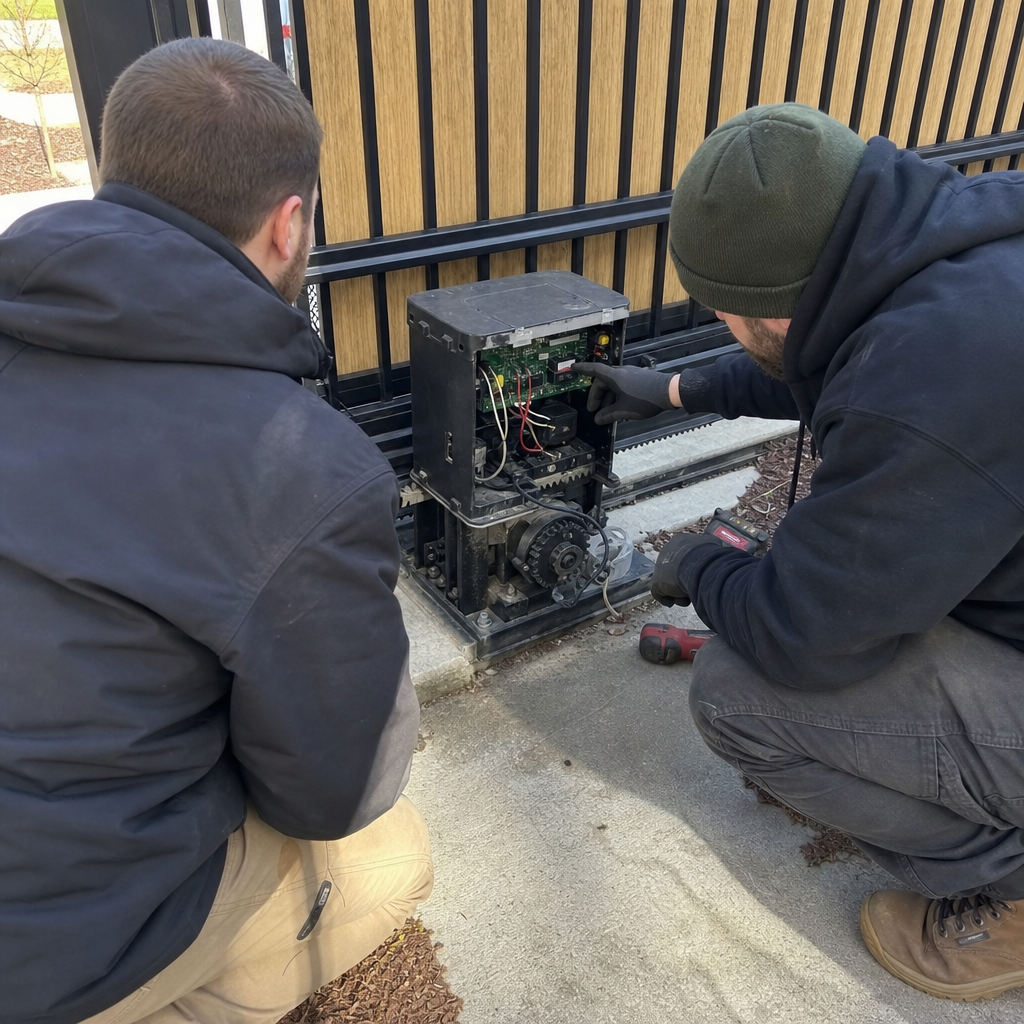
Some fixes need a specialist. Others need thirty seconds and a flashlight. Here’s what Douglas Ross checks first on every no-open call in Kansas — and what you can check yourself.
The Manual Release: Your Escape Hatch
Every automatic gate operator sold in the last thirty years has a manual release, and most homeowners have never touched theirs. It’s usually a key-turned lever or a pull-cord near the motor housing — on LiftMaster and Mighty Mule residential units, it’s a bright red handle or a small keyed lock. Disengaging it lets you push or pull the gate by hand to get a vehicle out while you troubleshoot.
Safety note: If your gate is on a slope or weighs more than you can comfortably stop with two hands, don’t try to muscle it alone. A runaway gate on a grade is dangerous — get help, or call us and we’ll walk you through securing it.
Power and Battery: The Kansas Storm Season Variable
Here’s a pattern we see every spring after the first severe weather rolls through Kansas: gate worked fine yesterday, won’t open today, and the remote clicks but nothing moves. Nine times out of ten, that’s a dead backup battery in the operator.
Gate operators run on 120V household power, but they rely on a 12V battery for surge protection and backup operation. When Kansas City Power & Light flickers during a storm, a weak battery takes the hit instead of the control board. One good surge kills it dead. The operator still shows lights — it’s getting wall power — but it can’t generate enough torque to move the gate.
Battery replacement runs $30–$75 for standard sealed lead-acid units, and it’s a five-minute swap if the battery compartment is accessible. If your operator is a FAAC or BFT commercial unit with an enclosed housing, the battery is harder to reach — that’s when a service call makes sense.
Obstruction Sensors: The Leaf, The Spider, The Shadow
Photo eyes and loop detectors don’t fail — they get fooled. A spiderweb across an infrared beam, a leaf stuck in a gate track, or even hard afternoon shadow across a sensor can trigger the safety shutdown. The gate starts to move, senses “obstruction,” and reverses or stops dead.
Wipe the lenses with a clean cloth, clear the track, and try again. If the gate runs fine in morning light but fails at 4 p.m., you’ve got a shadow problem — the sensor needs realignment, not replacement.
Reading the Symptom: A Diagnostic Tree for Kansas Gates
Same failure, different cause. Here’s how we branch the diagnosis based on what you’re actually seeing.
| What the Gate Does | Most Likely Cause | DIY or Call? |
|---|---|---|
| No response at all — no lights, no click, no hum | Tripped GFCI, blown fuse, or failed transformer | Check breaker and GFCI first; if those are good, call |
| Moves 6–12 inches, then stops or reverses | Mechanical bind or thermal overload | Check for physical obstruction; if clear, likely operator issue |
| Moves in wrong direction or won’t fully close | Limit switch drift or failed magnetic sensor | Call — limit adjustment needs calibration |
| Remote works, keypad doesn’t (or vice versa) | Failed entry device, not the operator | Keypad battery or wiring; often a simple fix |
| Worked fine for years, failed suddenly, no storm | Control board failure — most common “mystery” no-open | Call — board diagnosis and programming needed |
When It’s Not Electrical: Ground Heave and Mechanical Bind
In the older neighborhoods around Westheight Manor and Rosedale, where Douglas Ross grew up, we’ve seen this exact scenario a dozen times: homeowner calls convinced their Mighty Mule operator died over winter. We arrive, measure the gate post, and find it’s shifted 3/8 inch toward the latch. The gate still moves — until it doesn’t. The operator’s torque sensor reads the binding resistance as an obstacle and shuts down.
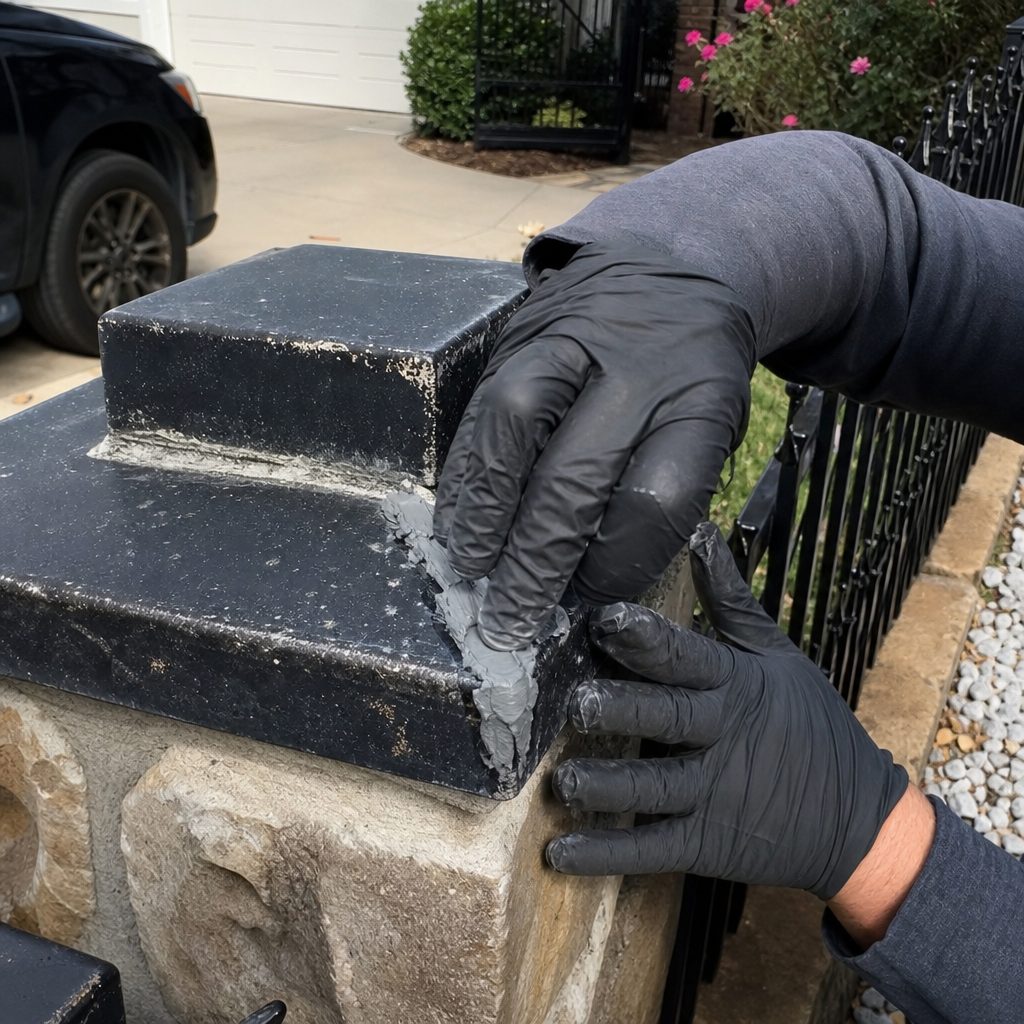
Fixing the post is a concrete and welding job, not an electrical one. That’s where our in-house fabrication capability matters — we can cut, weld, and reset hardware that a parts-swap technician would tell you to replace entirely. When a part isn’t available, we fabricate it — our in-house welding capability keeps your gate from becoming a replacement project.
The Thermal Cutoff: Kansas Summer’s Hidden Failure
July in Kansas hits 95°F with humidity that makes metal expand and motors overheat. A gate operator running in direct sun can hit its internal thermal cutoff and refuse to open until it cools — usually 15–30 minutes. If your gate works at 7 a.m. and 8 p.m. but quits at noon, that’s not a ghost in the machine. It’s the machine protecting itself from burning out.
Shade helps. So does a operator rated for your gate’s actual weight and cycle count — many Kansas installations are underspec’d for summer load. We see this on budget residential openers pushing gates they were never designed for.
Brand-Specific Quirks We’ve Learned the Hard Way
Twenty years of gate-only work means we’ve logged enough hours on each major system to know their failure signatures. Here are the patterns that show up in Kansas:
- LiftMaster residential operators: Excellent diagnostics through the MyQ app, but the wall-button wiring is prone to corrosion at the terminal block — looks like a dead operator, often just a $3 connector.
- Mighty Mule: Budget-friendly and common in Kansas City metro subdivisions, but the control boards are sensitive to voltage sag. If your house voltage runs low (common in older KCK neighborhoods), the board throws false error codes.
- FAAC and BFT (commercial): Built like tanks, but the hydraulic fluid needs seasonal viscosity adjustment. A FAAC 415 set up for California weather will struggle through a Kansas January until we re-tune it.
- Ghost Controls: Solar-friendly and popular on rural Kansas properties, but the battery-dependent design fails hard if the solar panel gets shaded by summer tree growth.
We service 9 major brands, so your system is never out of scope — but knowing which brand you have helps us bring the right parts and avoid a second trip.
What It Costs to Fix a Gate That Won’t Open in Kansas
Pricing depends on whether we’re replacing a battery or rebuilding a control system. Here’s what Kansas homeowners typically see:
| Service | Typical Range |
|---|---|
| Service call and diagnostic | $85–$150 |
| Backup battery replacement | $30–$75 (part) + labor |
| Photo eye or sensor replacement | $120–$250 |
| Limit switch adjustment or replacement | $150–$300 |
| Control board repair or replacement | $350–$800 |
| Post reset and mechanical weld repair | $400–$950 |
We don’t charge for estimates — if the fix is a battery you can swap yourself, we’ll tell you that on the phone and save you the trip. Douglas Ross takes the call and does the work — the owner is your technician, so you’re not paying for a dispatcher, a junior tech, and three layers of markup.
When to Call a Specialist vs. When to Wait
Here’s our honest read: if your gate ran fine for years and failed suddenly without a storm, impact, or obvious cause, the control board is the most statistically likely culprit — and that’s a diagnosis job, not a DIY job. Board-level repair requires test equipment, programming knowledge, and access to manufacturer firmware. We’ve inherited too many “fixed” boards from general handymen who swapped in a generic part and left the safety settings wrong.
On the other hand, if your gate failed right after a Kansas thunderstorm and you’ve got wall power everywhere else, try the battery first. If your gate moves a few inches and stops, check for physical binding before you assume the motor is dead.
Tell me what it’s doing — and what it was doing right before that. That’s usually where the answer is.
FAQs
The most common post-storm failure is a dead backup battery in the gate operator, killed by a voltage surge when Kansas City Power & Light flickered. The operator still gets wall power — lights and clicks still work — but it can’t generate enough torque to move the gate. Battery replacement runs $30–$75 and takes about five minutes if the compartment is accessible. Call (833) 754-6310 if you need help locating it or if the operator has an enclosed housing.
Repair is usually cheaper if the operator is under 10 years old and the failure is isolated to a battery, sensor, or limit switch — typically $120–$300. Replacement makes more sense when the control board has failed on an older unit, or when the original installer undersized the operator for your gate’s weight. A new residential opener runs $800–$1,800 installed, while commercial-grade FAAC or BFT systems start around $2,500. We’ll diagnose first and give you both numbers so you can decide.
Yes — for most no-open calls in Kansas, KS, we can diagnose and repair same-day if the issue is a battery, sensor, wiring fault, or limit adjustment. Control board replacements or post-reset welding jobs sometimes need a second trip if we need to fabricate a part. Call (833) 754-6310 with your symptoms and brand; we’ll tell you straight whether we can solve it today or need to schedule a return with the right components.
That’s almost always thermal cutoff or shadow interference. In Kansas summer heat, operators in direct sun can overheat and shut down until they cool — 15 to 30 minutes. Alternatively, afternoon sun angle can cast a hard shadow across a photo eye, tricking the safety system into seeing an obstruction. Check if the failure happens at the same time of day; if so, shade the operator or realign the sensor. If the pattern is temperature-dependent rather than time-dependent, the motor is likely undersized for summer load.
Stuck Now? Here’s What to Do
If you’ve checked the manual release, the breaker, and the battery, and your gate still won’t budge, you’ve reached the point where a misdiagnosis costs more than a service call. Two decades of gate-only experience means we’ve seen your exact problem before — and with Douglas Ross on every job, the most experienced person in the company is the one who shows up.
Halcyon Automatic Gate Repair Kansas offers a no-pressure assessment in Kansas — call (833) 754-6310 for a free estimate, or explore our full Gate Repair services to see what we handle.
Written by Douglas Ross, Owner & Lead Technician at Halcyon Automatic Gate Repair Kansas, serving Kansas, KS.